Sensex Falls Over 450 Points and Nifty Drops Below 24,200 as Banking and Metal Stocks Lead Market Decline on 08 May 2026

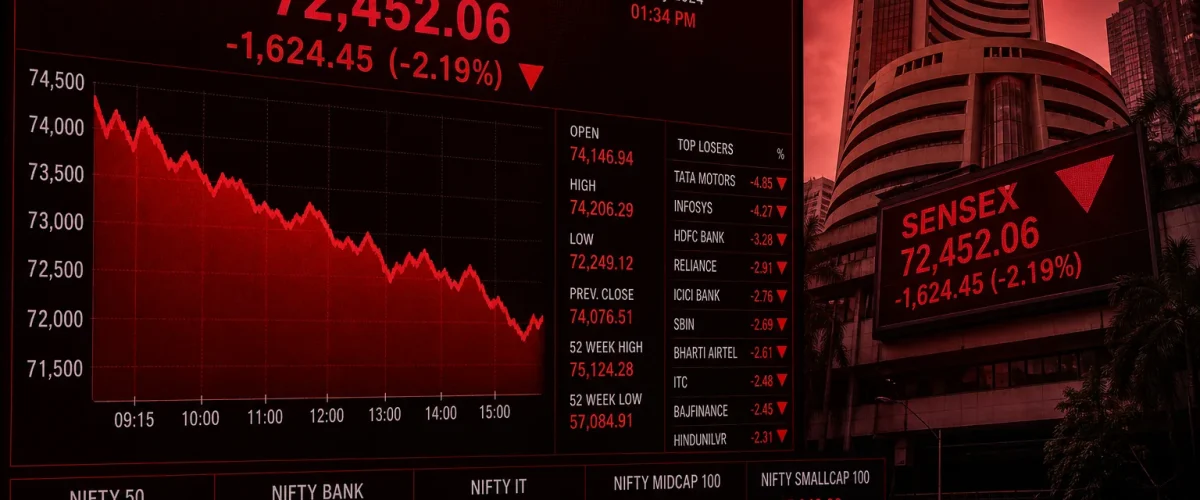
Indian equity markets extended their losing streak for a second consecutive session on 08 May 2026, with the BSE Sensex falling over 450 points and the NSE Nifty 50 dropping below the 24,200 mark. The decline was led by sharp losses in banking, financial services, oil and gas, realty, and metal stocks, signalling broad-based weakness across economically sensitive sectors. HDFC Bank and Coal India were among the hardest hit, each declining approximately 2 per cent during the session.
Market Overview: Second Straight Day of Losses
The Sensex, which had closed at 77,844.52 on Thursday after a marginal decline of 114 points, opened lower on Friday and continued to slide through the morning session. By mid-day, the 30-share index was trading at approximately 77,390, down over 450 points or 0.58 per cent from the previous close.
The Nifty 50 followed a similar trajectory, slipping below the psychologically important 24,200 level to trade near 24,150. GIFT Nifty on the NSE IX had signalled a negative opening, trading lower by 103.50 points, or 0.42 per cent, at 24,295 before the Indian market opened. The pre-market indicators proved prescient as selling pressure intensified once trading began.
Midcap and smallcap indices also slipped into the red but continued to outperform the benchmarks, suggesting that the selling was concentrated in large-cap heavyweights rather than representing a broad-based market rout. The Nifty Midcap 100 was down 0.3 per cent, while the Smallcap 250 index declined 0.2 per cent.
Banking Stocks Bear the Brunt
The banking and financial services sector, which carries the largest weightage in both the Sensex and Nifty, was the primary driver of the decline. HDFC Bank fell approximately 2 per cent, dragging the Sensex lower by an estimated 120 points on its own. Other banking stocks including State Bank of India, ICICI Bank, and Kotak Mahindra Bank also recorded losses of between 1 and 1.5 per cent.
Financial stocks have been under sustained pressure from foreign portfolio investor outflows, which have surpassed the entire 2025 total in just four months. FPIs have been net sellers of Indian equities for the fourth consecutive fortnight in the second half of April, with the sector’s significant index weightage making it particularly vulnerable to risk-off sentiment among overseas investors.
The Bank Nifty index declined 0.8 per cent, underperforming the broader market. Analysts attribute the persistent weakness in banking stocks to concerns about slowing credit growth, potential asset quality issues in the unsecured lending segment, and the impact of elevated crude oil prices on the broader economy.
Sectoral Analysis: IT and Healthcare Show Resilience
While most sectoral indices traded in the red, there were pockets of resilience. IT stocks showed modest gains, with the Nifty IT index rising 0.4 per cent, driven by strength in Infosys, TCS, and HCL Technologies. The healthcare sector also held firm, with Nifty Pharma gaining 0.3 per cent. Chemicals and midcap IT indices similarly showed selective buying interest.
Oil and gas stocks declined following the recent volatility in global crude prices. The Nifty Oil and Gas index was down 0.7 per cent, reflecting concerns about the impact of fluctuating Brent crude prices on refining margins and fuel demand. The recent crash in oil prices following US-Iran ceasefire talks provided temporary relief, but ongoing geopolitical uncertainty in the Middle East continues to weigh on energy sector sentiment.
Metal stocks were under pressure amid concerns about weakening Chinese demand and global trade tensions. Tata Steel, JSW Steel, and Hindalco all recorded losses of between 1 and 2 per cent. Realty stocks also declined, with DLF and Godrej Properties among the notable losers.
Macro Factors Driving Caution
Several macroeconomic factors are contributing to the cautious market sentiment. The US Federal Reserve held interest rates steady at 3.50 to 3.75 per cent at its April meeting, the third consecutive pause. While this was widely expected, dissent among FOMC members regarding the pace of future rate cuts has introduced uncertainty about the trajectory of US monetary policy.
The Indian rupee, which recently touched a record low against the US dollar, has stabilised in the 94.40 to 94.50 range but remains under pressure. A weaker rupee makes Indian equities less attractive to foreign investors and increases the cost of imported raw materials for domestic companies.
The recent market rally following election results has given way to profit-booking as investors reassess valuations in light of global headwinds. The Nifty 50 is currently trading at approximately 20 times forward earnings, which is above its 10-year average and leaves limited room for further expansion in the absence of strong earnings growth.
Global Cues Mixed
Global cues were mixed ahead of the Indian market open. US markets had closed higher on Thursday, with the S&P 500 gaining 0.3 per cent on the back of strong corporate earnings from Pfizer and other companies. However, Asian markets were mostly lower on Friday, with Japan’s Nikkei declining 0.5 per cent and Hong Kong’s Hang Seng falling 0.4 per cent, reflecting concerns about China’s economic slowdown.
European futures pointed to a mixed open, with investors awaiting the release of UK GDP data and eurozone industrial production figures. The global backdrop suggests that risk appetite remains fragile, with geopolitical tensions, inflation concerns, and central bank policy uncertainty all weighing on investor confidence.
Expert Views and Outlook
Market analysts advise caution in the near term but remain constructive on the medium-term outlook for Indian equities. The domestic consumption story, supported by steady GDP growth and improving rural demand, continues to provide a fundamental floor for the market.
Traders are watching the 24,000 level on the Nifty as a key support level. A break below this could trigger additional selling, potentially pushing the index towards the 23,800 range. On the upside, a recovery above 24,400 would signal a resumption of the recent uptrend.
For the coming week, market participants will closely monitor FPI flow data, crude oil price movements, and any developments on the global trade front. The quarterly earnings season, which is entering its final phase, could also provide stock-specific catalysts that drive sector rotation.
Track market movements on Markets and Business & Economy at Daily Tips.