Israel Built Secret Military Base in Iraqi Desert to Support Iran Air Campaign and Launched Airstrikes Against Iraqi Troops WSJ Reports

A bombshell report by the Wall Street Journal has revealed that Israel constructed a secret military base in the Iraqi desert to provide logistical support for its air campaign against Iran, in an operation that involved Israeli airstrikes against Iraqi military forces who nearly discovered the installation. The report, published on Saturday, May 9, 2026, cites multiple sources including US officials familiar with the matter and marks one of the most significant revelations about the scope of the US-Israeli military campaign against Iran.
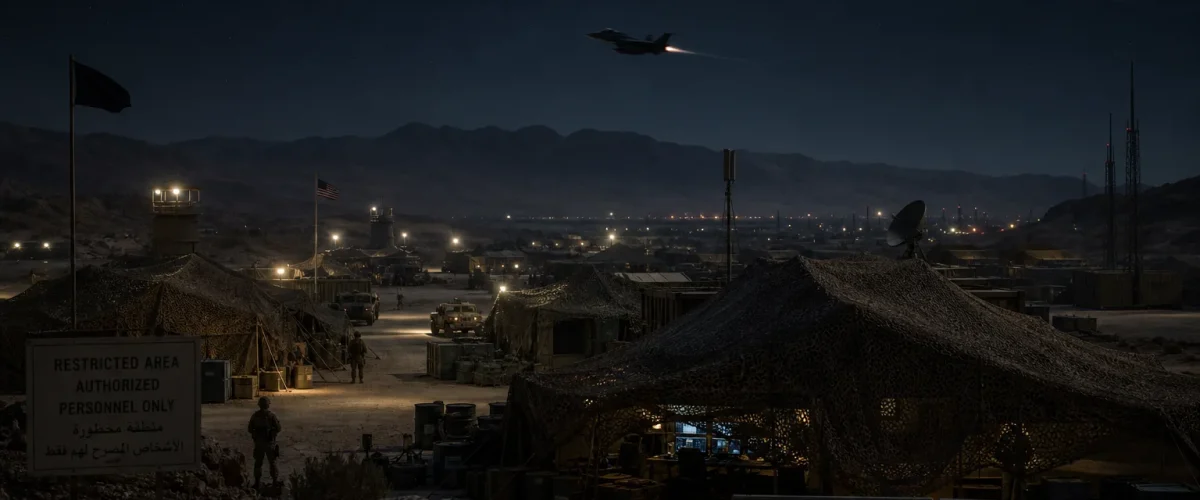
The clandestine outpost, whose exact location in western Iraq has not been publicly disclosed, reportedly housed Israeli special forces operators and served as a logistical hub for the Israeli Air Force during the conflict. It also included search-and-rescue teams positioned to assist any Israeli pilots who might be downed during strikes deep inside Iranian territory.
How the Base Was Built
According to the Journal’s reporting, Israel established the installation with the knowledge of the United States just before the start of the US-Israeli war against Iran. The base was designed as a forward operating position that would allow Israeli forces to sustain air operations over Iran from a location significantly closer than Israel’s own territory — reducing flight times, enabling more rapid sortie turnaround, and providing a recovery point for aircrew in distress.
The logistics of building and supplying a secret military base in a foreign country’s sovereign territory without that country’s knowledge are staggering. Sources cited by the Journal suggest that materials and personnel were moved into the site primarily by helicopter and C-130 transport aircraft operating under cover of darkness, using routes designed to avoid Iraqi military radar coverage.
The base reportedly included temporary shelters, fuel storage, communications equipment, medical facilities, and helicopter landing pads. While modest compared to permanent US military installations in the region, it represented a fully functional forward operating base capable of supporting extended operations.
The Shepherd, the Discovery, and the Airstrikes
The most dramatic element of the Journal’s report involves the near-discovery of the base. In early March 2026, a local shepherd reportedly noticed unusual military activity in the area, including helicopter movements that were inconsistent with normal Iraqi military operations. The shepherd reported his observations to local authorities, and Iraqi troops were dispatched to investigate.
As Iraqi forces approached the site, Israeli forces launched airstrikes to keep them at a distance, preventing the base from being discovered. The strikes were precise enough to deter the Iraqi troops without causing a broader military confrontation, but the incident triggered alarm within the Iraqi government.
Iraq subsequently filed a complaint with the United Nations in late March, describing the attack as involving “foreign forces and airstrikes.” Notably, Iraq attributed the attack to the United States, apparently unaware of Israeli involvement. The Journal cited a source familiar with the matter as confirming that the United States was not involved in the airstrikes — they were conducted solely by Israeli forces defending their clandestine installation.
Implications for US-Iraq Relations
The revelation that the base was established “with the knowledge of the United States” raises profound questions about Washington’s role in facilitating Israeli military operations on Iraqi soil without Baghdad’s consent. Iraq has hosted US military forces under bilateral agreements since the 2003 invasion, but those agreements do not extend to allowing third-country military operations on Iraqi territory.
Iraqi political leaders have reacted with fury to the report. Several prominent parliamentarians have called for an emergency session to discuss the revelations, with some demanding the expulsion of remaining US military advisers from the country. The Iraqi Foreign Ministry has summoned the US ambassador for an explanation, though no official statement had been issued at the time of publication.
The situation is particularly sensitive given the ongoing efforts to de-escalate the broader Middle East conflict that erupted following the Iran-UAE confrontation. Iraq, which shares long borders with both Iran and Saudi Arabia, has sought to maintain a neutral position in the regional tensions, making the revelation of a secret Israeli base on its soil deeply problematic for Baghdad’s diplomatic standing.
The Broader Iran Campaign
The secret base in Iraq appears to have been a critical element in the Israeli air campaign against Iran that unfolded in early 2026. The campaign, which targeted Iran’s nuclear facilities, air defence systems, and military infrastructure, involved hundreds of sorties over several weeks and represented the most extensive Israeli military operation in the country’s history.
Operating from Israeli territory alone would have required long-range flights over hostile or neutral airspace, with limited options for in-flight refuelling and no nearby recovery options for distressed aircrew. The Iraqi base solved several of these operational challenges simultaneously, allowing Israel to sustain a tempo of operations that would not have been possible from its own bases.
Defence analysts have noted that the base also provided a staging area for intelligence collection assets, including drones and electronic warfare equipment, that could operate at closer range to Iranian targets than would be possible from Israel.
International Legal Dimensions
The report raises complex questions under international law. The construction of a military base on a sovereign nation’s territory without that nation’s consent is widely regarded as a violation of state sovereignty, regardless of the operational justification. The subsequent airstrikes against Iraqi troops — even if conducted to prevent discovery rather than to cause casualties — add an additional layer of legal complexity.
International law experts suggest that Iraq could pursue the matter through the International Court of Justice or the United Nations Security Council, though the involvement of the United States as a Security Council veto-wielding permanent member complicates the latter avenue.
“This is an extraordinary violation of Iraqi sovereignty,” said Dr. Asli Bali, professor of international law at Yale Law School. “The fact that it was done with US knowledge implicates Washington in the violation. Iraq has every right to pursue legal remedies and to demand full accountability.”
Reactions and What Comes Next
Israel has not officially commented on the report, consistent with its long-standing policy of neither confirming nor denying covert operations. The US State Department issued a brief statement saying it would not comment on “intelligence matters or details of military operations.”
The revelation adds another dimension to the already complex geopolitical landscape in the Middle East, where multiple conflicts, ceasefires, and diplomatic initiatives are simultaneously in play. For Iraq, the immediate challenge is managing the domestic political fallout while maintaining its delicate balancing act between regional powers that have competing interests on its soil.
Reuters has noted that it could not independently verify the Journal’s report, and the full extent of the Israeli base’s operations — including whether it remains active or has been dismantled — remains unclear. What is clear, however, is that the revelation has fundamentally altered the political dynamics in the region and will likely have lasting consequences for US-Iraq, Israel-Iraq, and broader Middle Eastern relations.

- Indian Army Gets New Chief as General Dwivedi Hands Over Command Amid Push for Indigenous Defence Tech - July 1, 2026
- Ayodhya Ram Temple Donation Scandal Deepens as Trustees Resign and SIT Arrests Eight - June 29, 2026
- Bengal Seven Weeks On: Modi’s Historic Win and the Questions That Won’t Go Away - June 28, 2026