India Unveils National Roadmap for Quantum-Safe Cryptography to Shield Critical Digital Infrastructure

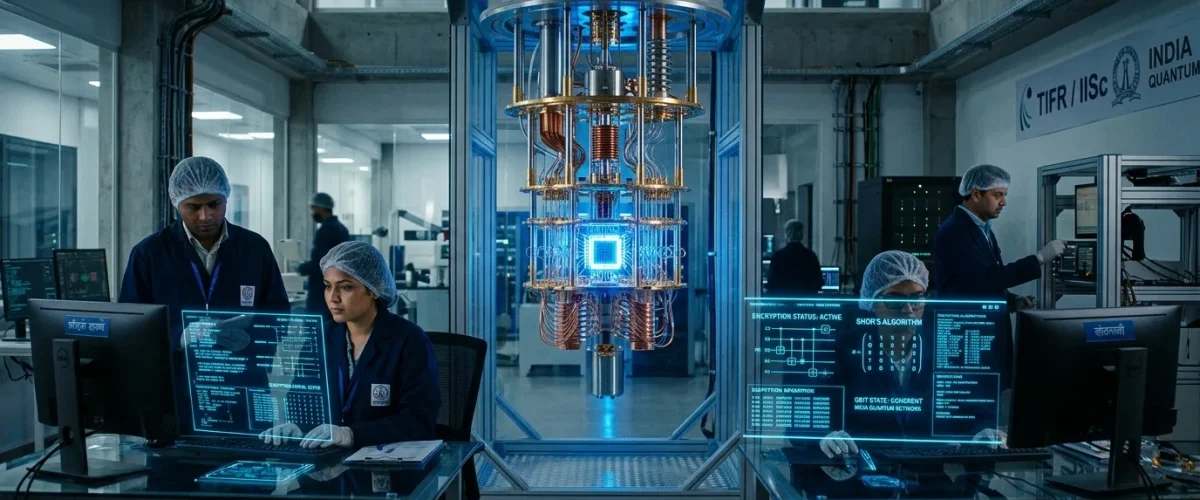
India has taken a decisive step towards securing its digital future with the unveiling of a comprehensive national roadmap for quantum-safe cryptography — a strategic framework designed to protect the country’s critical infrastructure, financial systems, and defence networks against the looming threat of quantum computing-enabled cyberattacks. The roadmap, developed by a dedicated task force under the Ministry of Electronics and Information Technology (MeitY), represents one of the most detailed national quantum security strategies published by any country to date.
The Quantum Threat: Why Now?
The urgency behind India’s quantum-safe initiative stems from a well-understood but increasingly pressing technological reality: the cryptographic algorithms that currently protect the vast majority of digital communications — including RSA, ECC, and Diffie-Hellman key exchange protocols — will become vulnerable to attack once sufficiently powerful quantum computers become operational. While such machines are not yet available, the consensus among quantum computing researchers is that they could emerge within the next decade, potentially as early as the late 2020s.
The threat is compounded by what security researchers call the “harvest now, decrypt later” strategy, in which adversaries intercept and store encrypted data today with the intention of decrypting it once quantum computing capabilities mature. For data with long-term sensitivity — including state secrets, financial records, and personal health information — this means the quantum threat is not a future problem but a present one.
“India cannot afford to wait until quantum computers are a reality to begin its transition to quantum-resistant cryptography,” stated the task force’s report, published in February 2026. “The migration of cryptographic systems is a complex, multi-year process that must begin now to ensure continuity of security.”
Key Pillars of the Roadmap
The national roadmap is structured around four principal pillars: standardisation, testing, phased migration, and capacity building.
Standardisation: India will adopt the post-quantum cryptographic algorithms recently finalised by the US National Institute of Standards and Technology (NIST), including CRYSTALS-Kyber for key encapsulation and CRYSTALS-Dilithium for digital signatures, while simultaneously supporting indigenous research into alternative lattice-based, hash-based, and code-based cryptographic schemes. The Bureau of Indian Standards (BIS) has been tasked with developing national standards for quantum-safe implementations tailored to India’s regulatory and technological context.
Testing: A national quantum cryptography testing laboratory will be established, with initial facilities planned at IIT Delhi and the Centre for Development of Advanced Computing (C-DAC) in Pune. These facilities will enable government agencies, financial institutions, and defence organisations to evaluate quantum-safe implementations in controlled environments before deploying them at scale.
Phased Migration: The roadmap proposes a three-phase migration timeline. Phase 1 (2026-2027) focuses on inventorying existing cryptographic assets and identifying systems of highest vulnerability. Phase 2 (2027-2029) involves hybrid implementations where quantum-safe algorithms run alongside existing ones. Phase 3 (2029-2032) targets full migration of all critical systems to quantum-resistant cryptography.
Capacity Building: Recognising that the transition will require a workforce proficient in both quantum computing and post-quantum cryptography, the roadmap mandates the integration of quantum security modules into computer science curricula at IITs, NITs, and other premier institutions. Scholarship programmes for doctoral research in quantum information science will be expanded under the National Quantum Mission.
The National Quantum Mission: A Foundation
India’s quantum-safe roadmap builds upon the National Quantum Mission (NQM), approved in 2023 with an allocation of ₹6,003 crore over eight years. The NQM encompasses quantum computing, quantum communication, quantum sensing, and quantum materials research, with designated thematic hubs at leading Indian institutions including IISc Bangalore, IIT Bombay, IIT Madras, and TIFR Mumbai.
Under the NQM’s quantum communication vertical, India has already demonstrated quantum key distribution (QKD) over fibre-optic networks spanning several hundred kilometres — a technology that uses the principles of quantum mechanics to create theoretically unbreakable communication channels. The roadmap envisions the deployment of QKD networks connecting major government data centres and military installations by 2030.
India’s quantum ambitions are closely linked to the country’s broader investments in space science and technology education, as both domains require advanced mathematical and computational expertise that the nation is actively cultivating through expanded training programmes.
Implications for India’s Digital Economy
The quantum-safe transition carries profound implications for India’s digital economy, which is projected to reach $1 trillion by 2030. The Unified Payments Interface (UPI), which processes over 14 billion transactions monthly, relies on cryptographic protocols that would be compromised by a sufficiently powerful quantum computer. Similarly, the Aadhaar biometric database, DigiLocker, and the Government e-Marketplace (GeM) platform all depend on encryption standards that must be upgraded.
The Reserve Bank of India has been designated as the lead agency for coordinating the quantum-safe transition in the financial sector, with guidelines expected to be issued to banks and payment service providers by late 2026. The Securities and Exchange Board of India (SEBI) is expected to follow with analogous mandates for capital market infrastructure.
Global Context and Competition
India’s roadmap positions the country among a select group of nations — including the United States, China, the European Union, and South Korea — that have published formal quantum security strategies. China, in particular, has invested heavily in both quantum computing and quantum communication, having launched the world’s first quantum satellite (Micius) in 2016 and deployed a 2,000-kilometre quantum communication backbone connecting Beijing and Shanghai.
The competitive dimension is not lost on Indian policymakers. “Quantum technology will be a defining factor in the geopolitical balance of the 21st century,” noted Dr. Ajay Kumar Sood, principal scientific adviser to the Government of India. “India’s roadmap ensures that we are not merely observers of this technological revolution but active shapers of its trajectory.”
The integration of quantum readiness into India’s broader technology policy reflects the same forward-thinking approach visible in the nation’s artificial intelligence strategy, where the imperative to combine ambition with institutional capacity building has emerged as a defining theme.
As India embarks on this complex but essential transition, the quantum-safe roadmap serves as both a technical blueprint and a statement of strategic intent — a declaration that the world’s most populous democracy intends to secure its digital sovereignty in the quantum age.