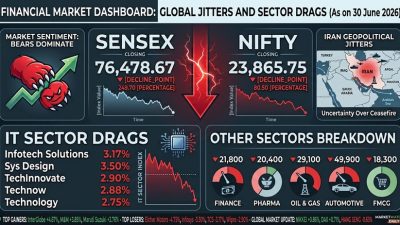
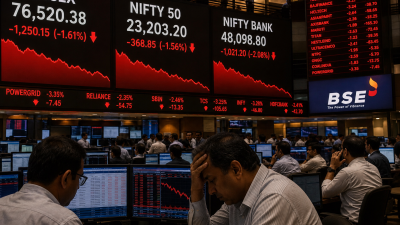
Sensex Crashes Over 840 Points, Nifty Slips Below 23,100 as Global Sell-Off Triggered by AI Bubble Fears and Surging Oil Prices Hits Dalal Street

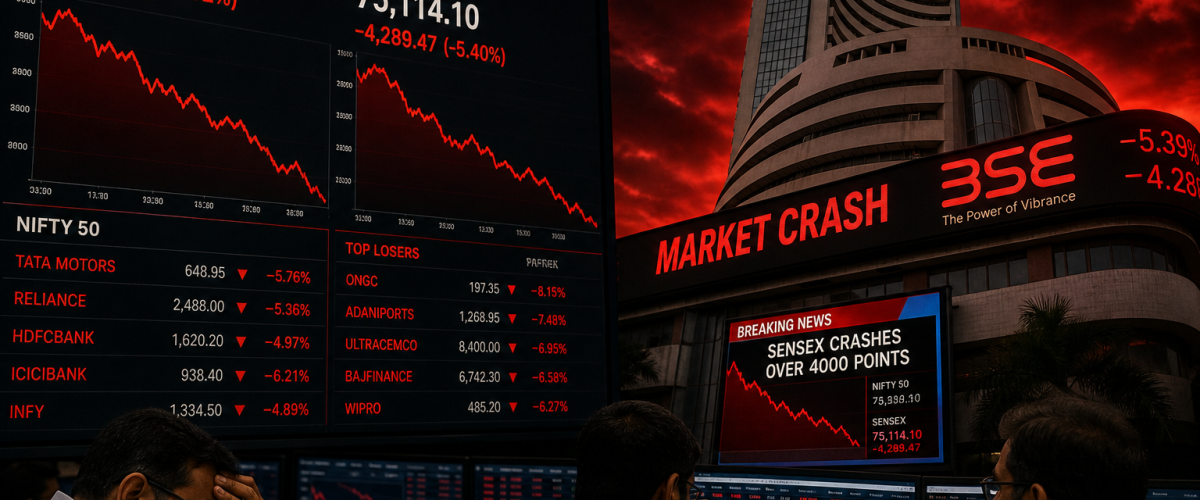
Indian equity markets opened to a brutal sell-off on Monday, 8 June 2026, with the BSE Sensex crashing over 840 points and the Nifty 50 slipping below the psychologically critical 23,100 level. The sharp decline came as a cascade of negative global signals — including mounting fears about the sustainability of the AI-driven stock market rally, surging crude oil prices, and escalating tensions in West Asia — converged to trigger risk-averse sentiment among investors worldwide.
The BSE Sensex declined 840.28 points, or 1.13 per cent, to 73,403.06 in early trade, while the Nifty 50 dropped 276.50 points, or 1.18 per cent, to 23,090.20. The weak opening had been telegraphed by GIFT Nifty, which plunged 356 points overnight, signalling a significant gap-down start for Indian markets. Broad-based selling was observed across sectors, with no major index escaping the carnage in the opening hour.
Global AI Sell-Off Spills Over
The proximate trigger for Monday’s rout was the sharp sell-off on Wall Street last week, where the Nasdaq crashed nearly 5 per cent — its worst weekly performance in months. The decline was led by Broadcom, the chip giant whose earnings beat expectations but whose forward guidance on AI chip revenue fell short of the sky-high expectations that had been baked into its share price.
Broadcom shares lost approximately $280 billion in market capitalisation in a single day, plunging over 15 per cent in what was its worst single-day crash in over a year. The sell-off rippled across the global technology sector, dragging down major US indices and reigniting fears that the multi-trillion-dollar AI investment theme may have outrun its near-term fundamentals.
The contagion spread to Asian markets on Monday morning, with Japan’s Nikkei 225 falling over 2 per cent, South Korea’s KOSPI declining 1.8 per cent, and Hong Kong’s Hang Seng Index dropping 1.5 per cent before Indian markets opened.
Crude Oil Surge Adds to Pressure
Compounding the AI-related sell-off was a sharp rise in global crude oil prices, driven by escalating tensions in West Asia. Brent crude surged past $88 per barrel, approaching the psychologically important $90 mark, as the ongoing conflict involving Iran, Israel, and Yemen continued to threaten maritime trade routes through the Strait of Hormuz.
India, which imports approximately 85 per cent of its crude oil requirements, is acutely sensitive to oil price spikes. Higher crude prices feed directly into inflation, widen the current account deficit, and put pressure on the rupee. The government recently approved a Rs 10,000 crore ATF price stabilisation fund to shield airlines from the fuel surge triggered by the Iran war — a measure that underscored the depth of concern about energy costs.
Oil-sensitive sectors including airlines, paint companies, and tyre manufacturers were among the hardest hit on Monday morning. Shares of InterGlobe Aviation (IndiGo) fell over 2 per cent in early trade.
FPI Outflows and Rate Concerns
Foreign portfolio investors (FPIs) have been net sellers in Indian markets for several consecutive sessions, pulling out capital amid concerns about rich valuations and the relative attractiveness of US assets offering higher yields. The prospect of the US Federal Reserve maintaining higher interest rates for longer — reinforced by a stronger-than-expected US non-farm payroll report on Friday — further dampened the appeal of emerging market equities.
India’s own monetary policy backdrop offered limited relief. The RBI held the repo rate unchanged at 5.25 per cent in its June meeting, with the Monetary Policy Committee unanimously voting for a neutral stance. While the hold was widely expected, the RBI’s cautious commentary on inflation — particularly food and fuel inflation — signalled that rate cuts were not imminent, removing a potential catalyst for a market rebound.
Sectoral Impact
The damage was broad-based, with all 13 sectoral indices on the NSE trading in the red during the opening session:
IT and technology stocks led the decline, mirroring the Nasdaq sell-off. Infosys, TCS, and HCL Technologies fell between 1.5 and 2.5 per cent. The Nifty IT index was among the worst performers.
Banking and financial stocks were also hit hard, with the Bank Nifty falling over 400 points. HDFC Bank, ICICI Bank, and SBI all registered losses exceeding 1 per cent.
Metal and energy stocks presented a mixed picture, with some metal counters recovering slightly on the back of higher commodity prices, while oil marketing companies faced pressure from surging input costs.
India’s declining position among global stock markets — it recently fell to 7th largest by market capitalisation — has added to investor anxiety about the country’s equity market trajectory.
What Should Investors Watch
Market strategists advised investors to remain cautious in the near term. Key factors to monitor include the trajectory of crude oil prices, any developments in the US-Iran negotiations that could ease the Strait of Hormuz blockade, and the direction of FPI flows in the coming sessions.
“The correction was overdue given the stretched valuations, particularly in mid-cap and small-cap segments,” said a Mumbai-based market analyst. “The trigger was global, but the vulnerability was domestic. Investors should use sharp dips to accumulate quality large-caps with earnings visibility.”
The next major domestic catalyst will be the monsoon’s progress — which hit Kerala in early June and is expected to advance northward — and its impact on agricultural output and food inflation. A strong monsoon could provide a fundamental counterweight to the current wave of global selling pressure.