Government Exempts FIIs from Capital Gains Tax on Government Securities Through Income Tax Amendment Ordinance 2026

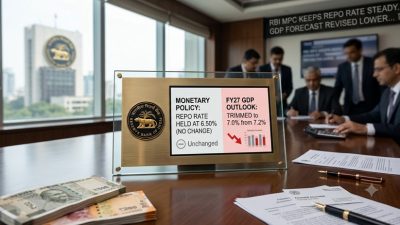
The Indian government issued the Income Tax (Amendment) Ordinance 2026, exempting Foreign Institutional Investors (FIIs) from both capital gains tax and withholding tax on government securities (G-Secs) with effect from 01 April 2026. The ordinance, announced alongside the RBI’s monetary policy decision to hold rates, represents one of the most significant tax concessions for foreign bond investors in India’s recent history.
The Bank for International Settlements (BIS) has also been granted identical exemptions under the ordinance. Market participants estimate the combined measures could attract $30-40 billion in fresh foreign flows into India’s government bond market over the next 12-18 months.
What the Exemption Covers
Under the previous tax regime, FIIs investing in Indian government securities were subject to a withholding tax on interest income and capital gains tax on profits from bond trading. These taxes, while not prohibitively high in isolation, added friction costs that made Indian G-Secs less competitive compared to government bonds in markets like Indonesia, Malaysia, and Thailand — all of which offer more favourable tax treatment for foreign investors.
The ordinance eliminates both levies entirely for G-Secs, creating a tax-neutral environment for foreign investors. Critically, the exemption applies only to government securities and does not extend to corporate bonds — a distinction that some market participants have noted as a limitation.
“The clarity is welcome, but the fact that it’s restricted to G-Secs means you won’t see the same flow into the corporate bond market, which arguably needs it more,” said Ananth Narayan, a professor of finance and former Standard Chartered treasury head. “Still, for sovereign bonds, this is a game-changer.”
Why It Matters Now
The timing of the ordinance is not coincidental. India’s inclusion in the JP Morgan Government Bond Index-Emerging Markets (GBI-EM), which began phased implementation in 2024, created a structural demand for Indian G-Secs from global index-tracking funds. However, the tax treatment remained a friction point that limited the pace of foreign inflows relative to the index weightage.
Also read: the RBI’s June monetary policy decision
By removing the tax barrier, the government is essentially clearing the last major obstacle for passive and active foreign investors who have India allocation mandates but were constrained by the after-tax return differential. The move also aligns with the RBI’s broader strategy to strengthen the rupee by encouraging dollar inflows through the capital account.
RBI Deputy Governor Poonam Gupta noted that gross FDI could cross $100 billion in FY27, with the tax exemption and swap support measures forming part of a coordinated effort to boost foreign capital flows. The swap window, separately announced, is expected to reduce hedge costs for foreign currency deposits and could lift FCNR(B) rates by up to 200 basis points.
Market Reaction and Flow Estimates
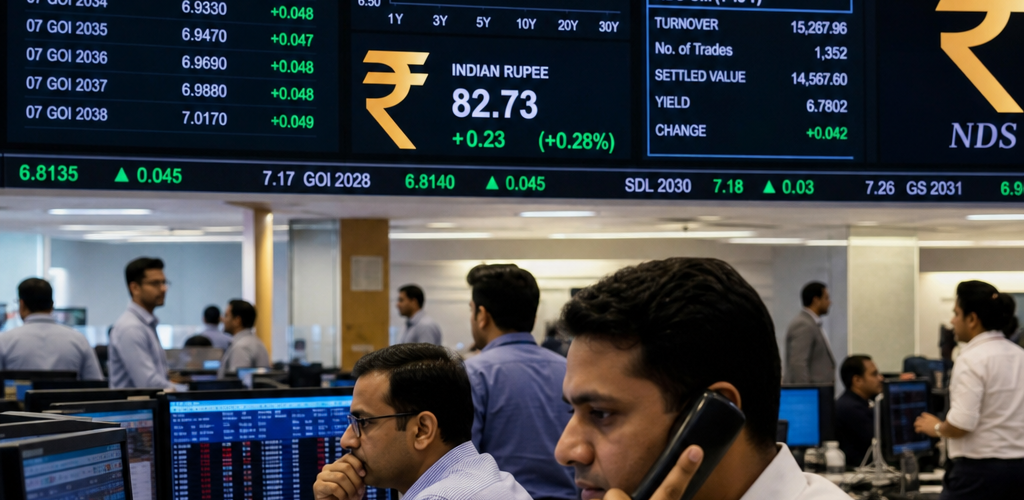
Bond traders responded positively to the announcement, with benchmark 10-year G-Sec yields declining by 4-5 basis points in post-announcement trading. The yield curve also flattened marginally, as foreign investors typically prefer longer-duration securities where the tax exemption provides the greatest benefit.
Analysts at major brokerages estimate the immediate impact could be $8-10 billion in incremental inflows over the next six months, with the full $30-40 billion materialising over a longer horizon as global fund managers adjust their allocations. India’s share in the GBI-EM index is expected to reach its maximum weightage of 10% by April 2025 as part of the phased inclusion, creating a natural flow of index-tracking capital.
“This is the kind of structural reform that changes the equation for India in global bond portfolios,” said a fixed-income portfolio manager at a Singapore-based asset manager. “The tax issue was the single biggest complaint we heard from clients about Indian bonds. With that removed, the relative value case becomes much cleaner.”
The Corporate Bond Gap
While the G-Sec exemption has been widely welcomed, the exclusion of corporate bonds from the ordinance has drawn criticism from some quarters. India’s corporate bond market, which is significantly less developed than its government bond market, could benefit substantially from similar tax treatment.
Also read: India’s recent slip to the 7th largest stock market
Industry body FICCI has urged the government to consider extending the exemption to corporate bonds in a subsequent phase, arguing that attracting foreign capital to the corporate bond market would reduce companies’ dependence on bank lending and deepen India’s capital markets.
For now, the government’s focus appears to be on maximising the impact for sovereign bonds, where the administrative machinery for foreign investor participation is already well established. Whether the corporate bond exemption follows will likely depend on the success of the G-Sec pilot and the government’s appetite for further revenue foregone in an election cycle.
Implications for the Rupee and Forex Reserves
The tax exemption carries important implications for India’s currency and reserves position. Sustained foreign inflows into G-Secs would strengthen demand for the rupee, potentially offsetting depreciation pressure from the trade deficit and crude oil imports. The RBI, which has been managing the rupee’s decline carefully through spot and forward market interventions, would benefit from an organic source of dollar supply that reduces the need for reserve drawdowns.
India’s foreign exchange reserves, which dipped below $620 billion earlier this year amid capital outflows and oil-related dollar demand, could see meaningful accretion if the G-Sec inflows materialise at the projected scale. A stronger reserves buffer would also enhance India’s sovereign credit profile and potentially support rating upgrades from agencies that have kept India at the lower end of investment grade.
Also read: ongoing India-US trade negotiations
“This is really about macro stability as much as market development,” said Samiran Chakraborty, chief economist at Citibank India. “If you can attract $30-40 billion in bond flows that are structurally anchored to index inclusion, that’s a permanent improvement in your balance of payments profile. The tax exemption makes the after-tax returns competitive with peer markets, which was the missing piece.”
The true test of the ordinance’s effectiveness will come over the next two quarters, as global fund managers recalibrate their allocations. If India’s G-Sec market can demonstrate that the tax-free environment is stable, predictable, and not subject to retrospective changes — a concern rooted in India’s 2012 retrospective tax episode — the flows should follow. The government’s use of an ordinance rather than a parliamentary amendment signals urgency and commitment, but investors will ultimately judge the policy by its longevity and consistency.