India Restricts Silver Imports With Immediate Effect as Government Mandates Licence for All Traders to Protect Forex Reserves

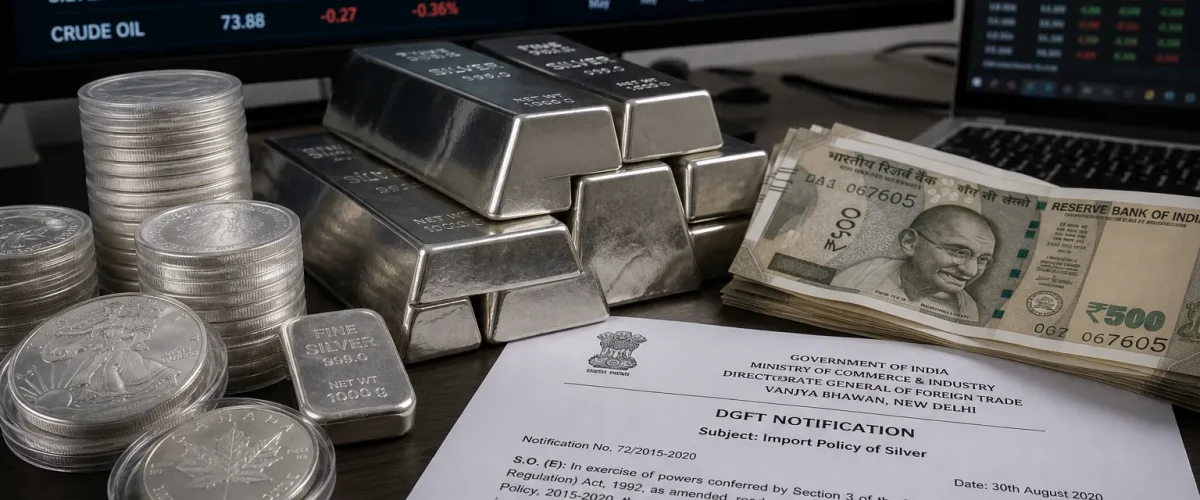
In a significant move to protect India’s foreign exchange reserves and curb surging precious metal imports, the Directorate General of Foreign Trade (DGFT) has shifted silver imports from the “free” category to “restricted” with immediate effect. The notification, issued on May 16 as Notification No. 17/2026-27, means that all importers will now need to obtain a government licence before bringing silver into the country — a dramatic change that has sent shockwaves through the bullion and jewellery trade.
What Has Changed and Why
Under India’s Foreign Trade Policy, imports are classified into three categories: free (no restrictions), restricted (requires government licence), and prohibited (not allowed). Silver, which was previously in the free category allowing anyone with an Importer Exporter Code (IEC) to import it without special permission, has now been moved to the restricted list.
The new licensing requirement, a major development in India’s business and economic policy, covers not only pure silver but also silver alloys mixed with gold and platinum, closing a potential loophole that traders could have used to circumvent the restrictions. The restriction applies to all forms of silver imports including bars, ingots, granules, and powder.
The move comes just three days after the government hiked the import duty on gold and silver from 6 per cent to 15 per cent in an emergency measure aimed at stemming the outflow of foreign exchange. India’s forex reserves have been under pressure since the onset of the West Asia oil crisis, with the rupee depreciating significantly against the US dollar over the past several weeks.
Why Silver Imports Were Targeted
India is the world’s largest consumer of silver, importing approximately 6,000 to 8,000 tonnes annually for industrial use, jewellery manufacturing, and investment purposes. Silver imports surged by over 40 per cent in the first quarter of 2026-27 compared to the same period last year, driven by a global price rally and strong domestic demand from the electronics and solar panel manufacturing sectors.
This surge in silver imports has been a significant contributor to India’s widening trade deficit, which reached a record $32 billion in April 2026. With the West Asia oil crisis pushing crude oil prices above $110 per barrel and the rupee under sustained pressure, the government has been forced to take aggressive measures to conserve foreign exchange.
“Silver imports were bleeding our forex reserves at a rate of nearly $2 billion per month. The combination of the duty hike and the licensing requirement should reduce imports by 50 to 60 per cent in the near term,” a senior Commerce Ministry official told the Economic Times on condition of anonymity.
Impact on the Bullion and Jewellery Trade
The silver import restriction has been met with alarm by India’s bullion trading community and jewellery industry, which together employ millions of people across the country. The India Bullion and Jewellers Association (IBJA) called the move “draconian” and warned that it would disrupt supply chains, push up domestic silver prices, and encourage smuggling.
“This is a death blow for small and medium silver traders who depend on imports for their business. The licensing process is lengthy and bureaucratic — it can take months to get approval. In the meantime, domestic prices will skyrocket and smuggling will become rampant,” said Surendra Mehta, National Secretary of IBJA.
Domestic silver prices jumped over 4 per cent on Saturday following the announcement, with silver futures on the Multi Commodity Exchange (MCX) touching Rs 1,87,000 per kilogram. Traders expect prices to rise further as the supply squeeze takes effect in the coming weeks.
Exemptions for Exporters and SEZs
The government has carved out important exemptions to protect India’s export-oriented industries. The restrictions will not apply to 100 per cent Export Oriented Units (EOUs), Special Economic Zones (SEZs), or firms importing silver under export-promotion schemes such as Advance Authorisation for products including jewellery, electronics, and solar panels.
This means that companies importing silver solely for manufacturing goods that are exported will continue to have unrestricted access to the metal. However, importers bringing silver into India for domestic consumption — including investment demand, local jewellery manufacturing for the domestic market, and industrial use — will need to go through the licensing process.
“The exemption for exporters is welcome, but the bulk of silver imports in India are for domestic consumption. The practical impact will be a significant reduction in total silver inflows,” said Ajay Kedia, Director of Kedia Advisory, a Mumbai-based commodity trading firm.
Broader Context: India’s Forex Defence Strategy
The silver import restriction is part of a broader strategy by the Indian government to defend its foreign exchange position amid the worst global energy crisis since the 1970s. Over the past month, the government has taken several aggressive measures including hiking gold and silver import duties, imposing restrictions on non-essential imports, and encouraging the Reserve Bank of India to intervene in the currency market to support the rupee.
India’s forex reserves have declined from a peak of $698 billion in September 2025 to approximately $610 billion as of May 2026, a drop of $88 billion driven primarily by the surging oil import bill and capital outflows, placing severe strain on India’s economy. The RBI has been using its reserves to prevent a disorderly decline in the rupee, but the pace of depletion has raised concerns among economists.
“The government is essentially fighting a war on multiple fronts — oil prices, commodity imports, capital outflows, and currency depreciation. The silver restriction is one tool in a larger arsenal, but it alone won’t solve the fundamental problem, which is the energy crisis,” said Dharmakirti Joshi, Chief Economist at CRISIL.
Historical Precedent
India has a long history of restricting precious metal imports during periods of economic stress. In 2013, during the “taper tantrum” currency crisis, the government imposed a 80:20 rule requiring that 20 per cent of all gold imports be re-exported, along with hiking import duties to 10 per cent. Those measures were largely credited with helping stabilise the current account deficit and the rupee at the time.
However, critics point out that such restrictions often have unintended consequences, including a surge in smuggling. During the 2013 gold import restrictions, gold smuggling into India increased dramatically, with enforcement agencies seizing record quantities of the metal at airports and borders. Silver traders and industry bodies have warned that a similar pattern could emerge if the current restrictions remain in place for an extended period.
The coming weeks will reveal whether the government’s aggressive approach succeeds in stabilising India’s external accounts, or whether the restrictions will need to be modified in the face of market disruption and industry pushback.