Gujarat Local Body Election Results 2026: BJP Sweeps All 15 Municipal Corporations With 856 Seats as Congress and AAP Face Wipeout Ahead of Assembly Polls

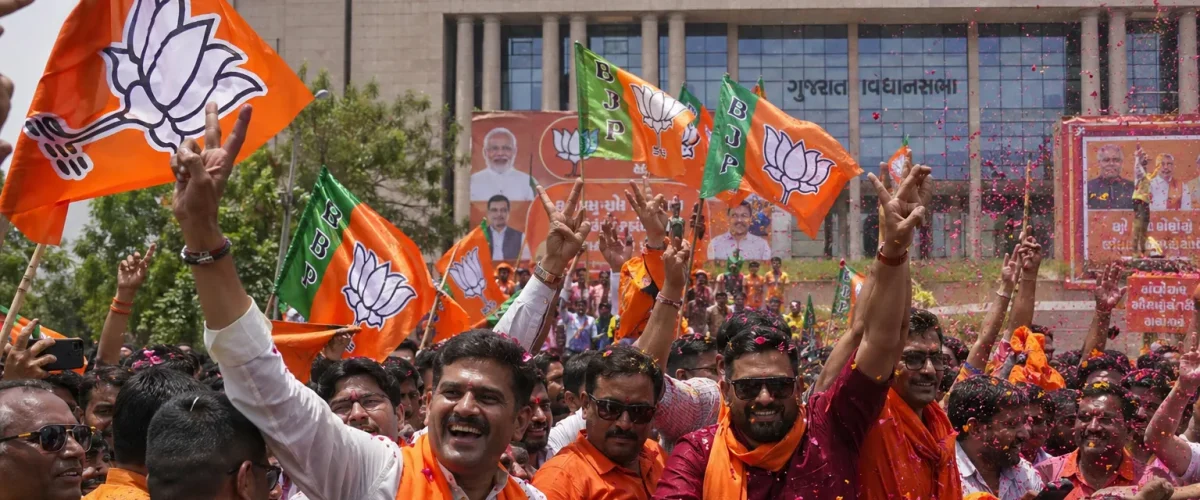
The Bharatiya Janata Party delivered a stunning electoral performance in Gujarat’s local body elections on Monday, 28 April 2026, sweeping all 15 municipal corporations and posting commanding victories across municipalities, district panchayats, and taluka panchayats. With results pouring in throughout the day, the BJP won 856 of the 1,044 municipal corporation seats — a dominance that left the Indian National Congress and the Aam Aadmi Party virtually wiped out from Gujarat’s urban governance landscape.
The results, coming from what was one of the state’s largest-ever local body electoral exercises covering nearly 9,992 seats with over 4.19 crore eligible voters, have sent a powerful political signal ahead of the Gujarat Assembly elections due next year. The BJP’s sweep across all tiers of local governance underscores its organisational stranglehold on the state and raises serious questions about the opposition’s ability to mount a credible challenge.
BJP’s Dominance Across All 15 Municipal Corporations
The scale of the BJP’s victory was staggering. In Ahmedabad, Gujarat’s largest city, the party won 158 of 192 seats, a commanding tally that left the Congress with barely a handful of wards. Across all six existing municipal corporations — Ahmedabad, Surat, Vadodara, Rajkot, Bhavnagar, and Jamnagar — the BJP maintained or expanded its already dominant positions, in many cases increasing its seat share compared to the previous round of local body elections.
The results were equally emphatic in the nine newly constituted municipal corporations — Navsari, Gandhidham, Morbi, Vapi, Anand (Karamsad-Anand), Nadiad, Mehsana, Porbandar, and Surendranagar. These new corporations, created as part of Gujarat’s urban expansion, were contesting their first-ever elections, and the BJP established control from the outset. In several of these new bodies, the party won more than 80 per cent of available seats, leaving no room for opposition parties to gain a foothold.
Party president J. P. Nadda congratulated the Gujarat unit and described the results as a “resounding endorsement of BJP’s governance model.” Chief Minister Bhupendra Patel, who had led an intensive door-to-door campaign across the state, called the victory “historic” and said it reflected the people’s faith in development-oriented governance.
Congress and AAP Face Devastating Losses
For the Indian National Congress, once the dominant force in Gujarat politics, the results were nothing short of catastrophic. The party, which had shown signs of revival in pockets of urban Gujarat in recent years, was reduced to single-digit tallies in most municipal corporations. In Ahmedabad, Congress won fewer than 15 seats — a far cry from its performance in previous elections when it had been the principal opposition force.
The Aam Aadmi Party, which had entered Gujarat politics with considerable fanfare ahead of the 2022 assembly elections and subsequently won seats in the Surat municipal corporation, suffered an even more comprehensive defeat. The party’s seat tally across all 15 corporations was in low double digits, a devastating blow to its ambitions of establishing itself as a viable third force in the state. AAP’s poor showing in Gujarat comes amid the party’s broader national decline, with several of its Rajya Sabha MPs recently merging with the BJP.
The AIMIM (All India Majlis-e-Ittehadul Muslimeen), which had contested in several urban constituencies, also failed to make significant inroads. Independents won a smattering of seats across corporations, but none in numbers sufficient to challenge the BJP’s absolute majority anywhere.
Results in Municipalities and Panchayats
The BJP’s dominance extended well beyond municipal corporations. In the 84 municipalities across the state, the party won a majority of seats in all but a handful of bodies, continuing a trend of growing saffron influence in Gujarat’s smaller towns and cities. The Congress managed to retain some presence in municipalities, particularly in areas with significant minority or tribal populations, but nowhere near enough to claim control of any municipal body.
In the 34 district panchayats and 260 taluka panchayats — which govern rural Gujarat — the BJP similarly posted commanding victories. The party’s rural outreach, bolstered by schemes like the PM-KISAN direct benefit transfer and improvements to rural road connectivity, appeared to have paid dividends. Voter turnout in panchayat elections was notably higher than in urban areas, at 66.64 per cent for district panchayats and 67.26 per cent for taluka panchayats, compared to 55.1 per cent in municipal corporations and 65.53 per cent in municipalities.
What the Results Mean for Gujarat Assembly Elections 2027
Political analysts view the local body results as a strong indicator of BJP’s prospects in the Gujarat Assembly elections, which are expected to be held in late 2027. Local body elections in Gujarat have historically served as a reliable bellwether for state-level polls, and the BJP’s sweep suggests that the party’s organisational machinery remains formidable.
“The opposition simply does not exist in Gujarat at the local governance level,” said political commentator Vidyut Joshi. “Congress has been decimated systematically over the past decade, and AAP’s Gujarat experiment has effectively failed. Unless there is a dramatic realignment of opposition forces, the BJP is on course for a seventh consecutive assembly election victory in the state.”
The results also have implications for national politics. Gujarat, Prime Minister Narendra Modi’s home state, has been a BJP bastion for over two decades. A strong showing in local body elections reinforces the party’s narrative of grassroots support and governance credibility, which it will leverage in the lead-up to the next general elections.