NEET UG 2026 Records Historic 96.92 Per Cent Attendance as Over 22 Lakh Students Appear Across 5,432 Centres in 37 States and Union Territories

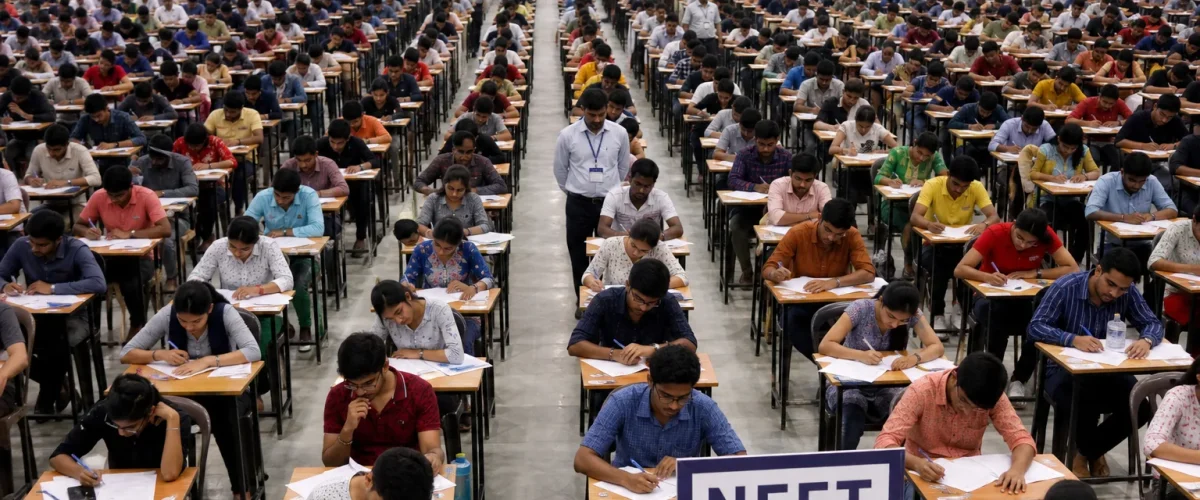
Record Turnout as India’s Largest Medical Entrance Exam Concludes Successfully
The National Eligibility cum Entrance Test (NEET) UG 2026 was conducted successfully across India on Sunday, 3 May 2026, recording a historic attendance rate of 96.92 per cent, with 22,05,035 out of 22,75,011 registered candidates appearing for the exam. The National Testing Agency (NTA) confirmed the figures in a post on its official social media platform, marking this as one of the highest attendance rates in the exam’s history and validating the stringent measures taken to ensure smooth conduct.
The exam was conducted across 5,432 centres in 565 cities spanning 37 States and Union Territories, making it one of the largest single-day examinations in the world. The elaborate security arrangements, including AI-powered surveillance, zero-leak protocols, and multiple layers of identity verification, appear to have achieved their intended effect of ensuring both fairness and high participation.
Scale and Logistics: Managing a 22-Lakh-Strong Examination
Conducting an examination of NEET UG’s scale is a logistical challenge that rivals major military operations. The NTA deployed over 50,000 invigilators, 20,000 support staff, and thousands of security personnel across the 5,432 centres. Each centre was equipped with CCTV surveillance systems, many enhanced with AI-powered monitoring that could flag suspicious behaviour in real-time.
Candidates were required to arrive at centres by 11:30 AM for the 2:00 PM to 5:20 PM exam window, with elaborate check-in procedures including biometric verification, photograph matching, and multi-layer frisking. The strict protocols meant that some candidates faced long queues at popular centres, particularly in major cities like Delhi, Mumbai, Chennai, and Hyderabad, but NTA officials said no significant disruptions were reported.
AI Surveillance and Zero-Leak Policy
The 2026 edition of NEET UG implemented the most comprehensive anti-cheating measures in the exam’s history, building on lessons learned from past controversies. The AI-powered surveillance system used machine learning algorithms to monitor live feeds from examination halls, flagging anomalies such as unusual movement patterns, potential communication between candidates, and suspicious behaviour near mobile phone detection zones.
NTA’s zero-leak policy involved multiple encrypted versions of the question paper, with the final version assigned to each centre determined only hours before the exam. This approach, combined with strict transport protocols for question paper delivery and real-time monitoring of the distribution chain, represents a significant upgrade from previous years’ security frameworks.
What the 96.92 Per Cent Attendance Signifies
The near-97 per cent attendance rate is remarkable for several reasons. First, it indicates that logistical barriers — including transportation challenges in remote areas, health issues, and documentation problems — affected fewer than 3 per cent of registered candidates. This suggests that the NTA’s efforts to improve centre allocation and provide candidates with centres closer to their homes are yielding results.
Second, the high attendance reflects the high stakes involved. NEET UG is the sole gateway to undergraduate medical, dental, and AYUSH admissions across India’s government and private medical colleges. With approximately 1.1 lakh MBBS seats and a similar number of BDS and AYUSH seats at stake, even candidates who faced personal difficulties made every effort to appear.
Third, the number indicates growing aspiration for medical careers in India. The total registered candidates of approximately 22.79 lakh represents a continued upward trend from previous years, reflecting India’s demographic dividend and the increasing value placed on medical education by middle-class and aspirational families. The demand for healthcare professionals is rising in India, driven by the expanding health insurance coverage and government investment in public health infrastructure.
State-Wise Trends and Notable Observations
While national attendance was 96.92 per cent, there were variations across states and union territories. Southern states, particularly Tamil Nadu, Kerala, and Karnataka, traditionally record among the highest NEET attendance and participation rates, reflecting the region’s strong emphasis on professional education. Northern and eastern states have been steadily closing the gap, with improved access to coaching and preparation resources.
Candidates with disabilities were provided separate exam rooms with additional time and assistance as per NTA guidelines. The agency confirmed that all accessibility accommodations were implemented as planned, a measure that has been progressively improved over successive NEET cycles following court directives and advocacy by disability rights organisations.
What Happens Next: Answer Keys, Results Timeline
With the exam concluded, the NTA will release official provisional answer keys in the coming days, allowing candidates to calculate their probable scores. Candidates will have a window to raise objections to specific questions or answers, after which the NTA’s expert panel will review challenges and issue the final answer key.
The NEET UG 2026 results are expected to be declared within four to six weeks of the examination date, tentatively by mid-June 2026. The results will include individual scorecards, all-India ranks, state merit positions, and category-wise rankings. Counselling for admissions under the All India Quota (AIQ) — managed by the Medical Counselling Committee (MCC) — typically begins shortly after results are announced.
For the 22 lakh students who appeared, the months ahead will be filled with anticipation and anxiety as they await results that will shape their educational and professional futures. The government’s recent focus on public safety and improving infrastructure extends to educational institutions, with new medical colleges being established across the country to expand the number of available seats and reduce the intense competition that makes NEET one of the most challenging entrance exams in the world.
The successful conduct of NEET UG 2026 with record attendance and no reported paper leaks marks a positive step for India’s examination ecosystem, offering hope that large-scale, high-stakes testing can be conducted fairly and efficiently when supported by adequate investment in technology and security infrastructure.