BRICS NSA Meeting Tomorrow: India’s Biggest Security Dialogue Under Ajit Doval

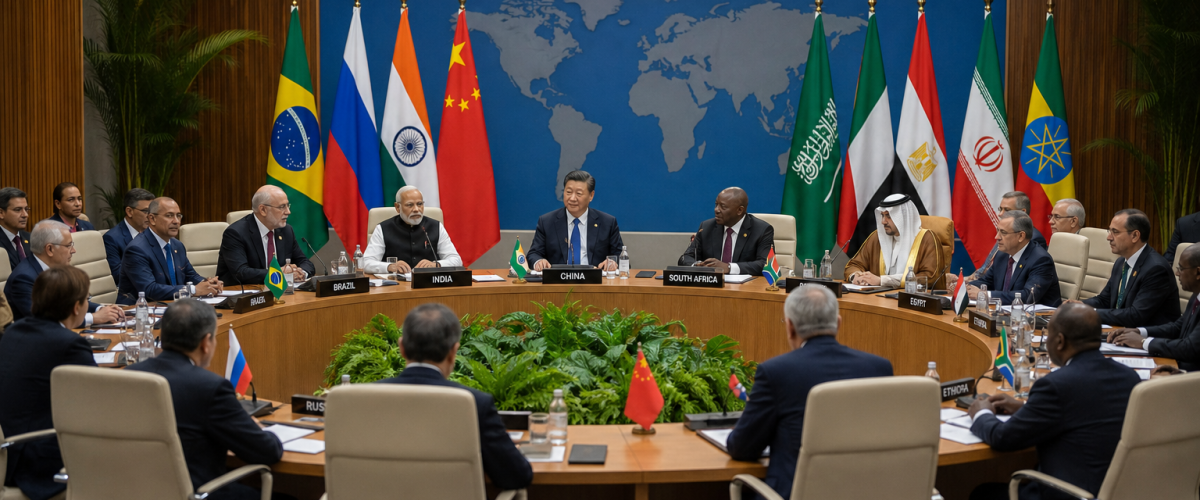
India’s largest multilateral security dialogue in years will begin tomorrow when National Security Adviser Ajit Doval chairs the BRICS National Security Advisers’ Meeting on June 22-23. The two-day summit — one of the most significant events under India’s 2026 BRICS Chairship — will bring together the national security chiefs of all ten BRICS member nations for discussions centred on cyber threats, counter-terrorism, and the security implications of emerging technologies.
The meeting arrives at a moment of acute global tension. The US-Iran MOU framework remains fragile, the G7’s Évian communiqué has explicitly targeted Russian assets and Chinese economic practices, and the ongoing FIFA World Cup in the United States has placed geopolitical rivals in uncomfortable proximity. Against this backdrop, India’s ability to host a productive security dialogue among nations with sharply divergent interests will be a significant diplomatic test.
The Agenda
The meeting’s stated focus on “non-traditional security challenges confronting the world today” is a diplomatic masterstroke by India — framing the dialogue around threats that all members face, regardless of their geopolitical alignment:
Cyber Warfare: The proliferation of state-sponsored cyber attacks on critical infrastructure — power grids, financial systems, healthcare networks — has made cybersecurity the most urgent non-traditional security challenge globally. The BRICS NSAs will discuss coordinated responses, information-sharing protocols, and norms for state behaviour in cyberspace.
Counter-Terrorism: The meeting will review outcomes from recently held BRICS Joint Working Groups on Counter-Terrorism, assessing progress on intelligence-sharing frameworks and the financing of terrorist organisations. India’s extensive experience with cross-border terrorism gives it particular credibility as a convener of these discussions.
AI and Autonomous Weapons: The intersection of artificial intelligence, quantum computing, and autonomous weapons systems with national security is a relatively new but rapidly growing concern. The BRICS forum provides a platform for establishing guidelines and norms in areas where global governance frameworks are still nascent.
The Diplomatic Chessboard
The meeting’s most significant undercurrent is the presence of both Russian and Chinese national security chiefs at a forum chaired by India:
Russia: Moscow’s participation comes against the backdrop of the Ukraine conflict and the G7’s increasingly aggressive posture towards Russian state assets. For Russia, the BRICS NSA meeting is an opportunity to demonstrate that it maintains strong security relationships outside the Western bloc — a counternarrative to the isolation that the G7 seeks to impose.
China: Beijing’s participation carries the weight of its unresolved border tensions with India and its expanding security footprint in the Indo-Pacific. The Doval-led format requires China to engage with India as a peer and host — a dynamic that Beijing finds increasingly uncomfortable as its own multilateral ambitions compete with India’s growing diplomatic clout.
Iran and Saudi Arabia: The presence of both Iranian and Saudi Arabian security chiefs at the same table — facilitated by India’s hosting — is itself a remarkable diplomatic achievement, given the two nations’ long-standing regional rivalry.
India’s Strategic Gains
For India, the BRICS NSA meeting serves multiple strategic objectives: it positions Doval as one of the world’s most influential security diplomats, strengthens India’s case for permanent UN Security Council membership, and demonstrates that India can manage multilateral security dialogues involving geopolitical rivals — a capability that few nations possess.
The outcomes of the June 22-23 meeting — particularly the joint statement’s language on cyber norms, counter-terrorism cooperation, and technology governance — will be closely analysed by strategic affairs experts worldwide.
Also Read
- India to Host BRICS Security Advisers’ Meet: Ajit Doval Chairs June 22-23 Talks on Cyber Threats
- US-Iran MOU Explained: What the Framework Deal Covers and Why It Matters for India’s Energy Security
- India-France Adopt Innovation Roadmap 2030 and Launch New Economic Security Dialogue
- Axiom Mission 4: Indian Astronaut Subhanshu Shukla Completes Historic 14-Day Stay on International Space Station
- BRICS Agriculture Ministers to Meet in Indore — Five-Day Summit to Focus on Food Security, Smart Farming and AI in Agriculture

- Indian Army Gets New Chief as General Dwivedi Hands Over Command Amid Push for Indigenous Defence Tech - July 1, 2026
- Ayodhya Ram Temple Donation Scandal Deepens as Trustees Resign and SIT Arrests Eight - June 29, 2026
- Bengal Seven Weeks On: Modi’s Historic Win and the Questions That Won’t Go Away - June 28, 2026