India-France Adopt Innovation Roadmap 2030 and Launch New Economic Security Dialogue

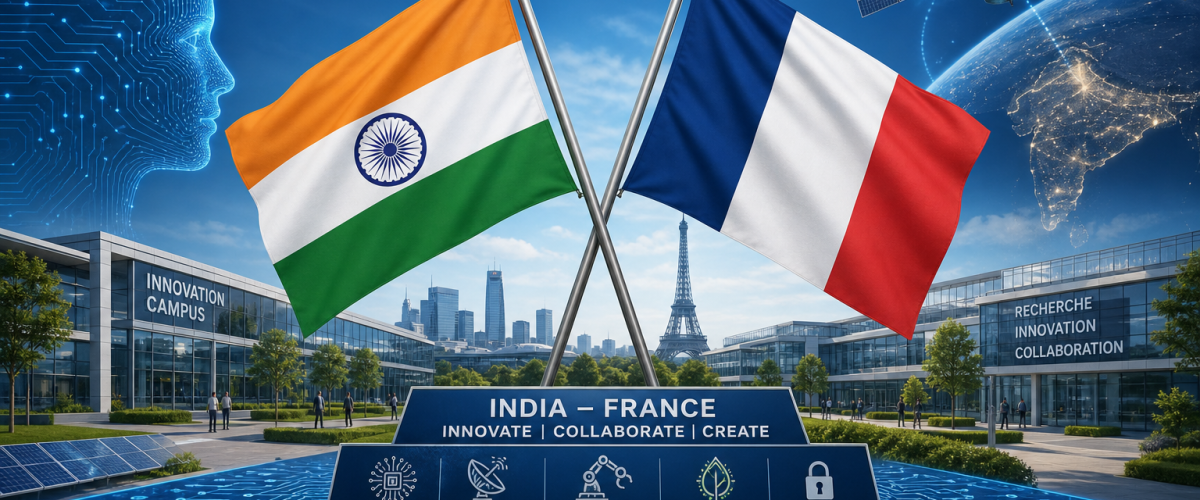
India and France have adopted a sweeping Innovation Roadmap 2030 and launched a new Economic Security Dialogue, marking a significant deepening of the bilateral relationship between two of the world’s most strategically important democracies. The agreements, finalised during PM Modi’s visit to France for the G7 Summit in Évian-les-Bains, establish a comprehensive framework for technology cooperation, joint research, and economic coordination that extends across artificial intelligence, cybersecurity, quantum computing, space technology, and clean energy.
The Innovation Roadmap 2030, adopted by PM Modi and President Emmanuel Macron, sets out a seven-year plan for structured collaboration between Indian and French research institutions, technology companies, and government agencies. The roadmap identifies priority sectors, establishes joint funding mechanisms, and creates institutional pathways for technology transfer and co-development — a level of specificity that distinguishes it from the more general partnership agreements that typically emerge from bilateral summits.
What the Innovation Roadmap Covers
The roadmap is organised around six priority areas that reflect the technological frontiers where India and France see the greatest potential for mutually beneficial collaboration:
Artificial Intelligence: The two countries will establish joint AI research centres, share datasets for training multilingual AI models, and collaborate on AI governance frameworks. France’s strengths in AI research — particularly through institutions like INRIA and the Paris AI ecosystem — complement India’s advantages in AI deployment at scale and multilingual model development.
Cybersecurity: As both countries face growing cyber threats from state and non-state actors, the roadmap establishes a framework for intelligence sharing, joint exercises, and the co-development of defensive technologies. The agreement includes provisions for protecting critical infrastructure, financial systems, and government networks.
Quantum Computing: India and France will collaborate on quantum research, with a focus on developing quantum computing applications for specific use cases including materials science, drug discovery, and cryptography. France’s investments in quantum technology — including through the French Quantum Plan — provide a strong foundation for collaboration with India’s emerging quantum ecosystem.
Space Technology: Building on the existing collaboration between ISRO and CNES (the French space agency), the roadmap expands cooperation to include satellite communications, Earth observation, and space debris management. The India-France space partnership is one of the most mature technology relationships between the two countries, and the roadmap builds on decades of successful cooperation.
Clean Energy: The roadmap includes commitments to joint research on solar technology, hydrogen, nuclear energy, and energy storage. France’s expertise in nuclear energy — it generates approximately 70% of its electricity from nuclear power — is of particular interest to India as it seeks to expand its nuclear energy capacity to meet growing demand while reducing carbon emissions.
Healthcare and Biotechnology: The two countries will collaborate on pharmaceutical research, vaccine development, and digital health solutions. The COVID-19 pandemic demonstrated the importance of international cooperation in healthcare, and the roadmap institutionalises this lesson through specific commitments and funding mechanisms.
The Economic Security Dialogue
The new Economic Security Dialogue represents a recognition by both countries that economic and technological issues have become central to national security. The dialogue will focus on supply chain resilience, critical minerals, semiconductor policy, and the protection of sensitive technologies — issues that have become increasingly important as geopolitical competition reshapes the global economic landscape.
For India, the dialogue provides a platform to coordinate with France on issues including the diversification of supply chains away from China, the development of domestic semiconductor manufacturing capabilities, and the regulation of technology exports. For France, the partnership offers access to India’s growing market and its strategic position in the Indo-Pacific region.
The Strategic Significance
The India-France relationship has evolved significantly over the past decade, from a primarily defence-focused partnership to a comprehensive strategic alliance that spans technology, economy, climate, and geopolitics. France was the first major European power to articulate an Indo-Pacific strategy that aligned with India’s vision for the region, and the two countries have cooperated on issues ranging from maritime security to climate finance.
The Innovation Roadmap 2030 and Economic Security Dialogue represent the latest phase of this evolution, reflecting a shared recognition that the challenges of the next decade — AI governance, climate change, supply chain resilience, and geopolitical competition — require precisely the kind of structured, long-term collaboration that the new agreements establish.
For India’s technology sector, the roadmap opens doors to French research institutions, investment, and markets. For France, the partnership provides access to India’s massive talent pool, growing AI capabilities, and the world’s largest laboratory for technology deployment at scale. The success of the partnership will depend on execution — but the ambition and specificity of the agreements suggest that both sides are serious about translating diplomatic intent into tangible outcomes.
Also Read
- Bharat Innovates 2026: PM Modi and Macron Inaugurate Global Deep-Tech Conclave in Nice, France
- Trump Praises Modi as ‘Good Friend’ and Says US Will Finalise Trade Deal with India Soon After Reversing Years of Trade Imbalance
- India and US Resume High-Level Trade Talks in New Delhi — Interim Bilateral Trade Deal Nearly Finalised Says Piyush Goyal
- G7 Summit 2026 Opens in Évian-les-Bains — PM Modi Joins World Leaders, Trump Bilateral Expected
- PM Modi Arrives in Slovakia — First Indian Prime Minister to Visit Since 1993 Independence