PM Modi Arrives in Slovakia — First Indian Prime Minister to Visit Since 1993 Independence

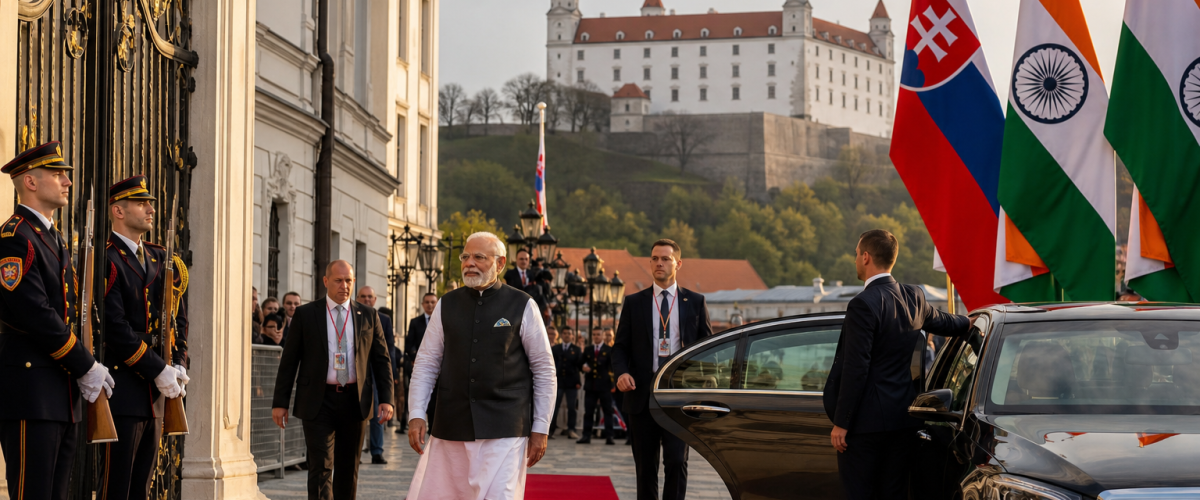
Prime Minister Narendra Modi arrived in Bratislava on Sunday for a historic two-day visit to Slovakia, becoming the first Indian Prime Minister to visit the country since its independence in 1993. The visit, the second leg of Modi’s three-nation European tour following his engagements in France, is aimed at deepening bilateral cooperation in trade, technology, defence, and investment between India and the Central European nation.
Modi was received with full ceremonial honours at Bratislava’s presidential palace, where he is scheduled to hold bilateral talks with Slovak President Peter Pellegrini and Prime Minister Robert Fico. The visit underscores India’s strategic recalibration towards Central and Eastern Europe — a region that has gained significance as a manufacturing hub, technology corridor, and diplomatic bridge within the European Union.
Why Slovakia Matters for India
Slovakia, though small in size with a population of approximately 5.4 million, punches above its weight in several sectors of strategic interest to India. The country is one of Europe’s leading automobile manufacturers per capita, hosting production facilities for Volkswagen, Kia, Stellantis, and Jaguar Land Rover. Its engineering expertise, particularly in automotive technology, electronics, and precision manufacturing, offers significant synergies with India’s growing industrial ambitions.
Bilateral trade between India and Slovakia currently stands at approximately $1.5 billion annually — a figure that both governments acknowledge falls far short of potential. The visit is expected to produce several memoranda of understanding covering technology transfer, defence cooperation, education exchanges, and startup ecosystem collaboration.
Slovakia’s membership in the European Union and the Eurozone also gives it strategic importance as a gateway for Indian businesses seeking to expand their European footprint. Several Indian IT companies, including TCS and Infosys, already have operations in neighbouring countries, and Slovakia’s skilled workforce and competitive costs make it an attractive destination for expansion.
Defence and Security Cooperation
Defence cooperation is expected to feature prominently in the bilateral discussions. Slovakia has been modernising its armed forces, having recently committed to NATO’s two-percent GDP defence spending target. The country has been actively seeking defence partners beyond its traditional European suppliers, and India’s growing defence manufacturing sector — bolstered by the Make in India initiative — presents opportunities for collaboration.
Areas of potential defence cooperation include the joint development and production of ammunition, armoured vehicles, and drone systems. India’s BrahMos Aerospace, which has been expanding its export portfolio, is reportedly in preliminary discussions with several Central European nations about missile systems, though no specific Slovak deal has been announced.
Cybersecurity and counter-terrorism cooperation are also on the agenda, reflecting shared concerns about digital threats and the evolving security landscape in Europe and South Asia. Both countries have expressed interest in establishing a regular security dialogue to address these challenges collaboratively.
The European Tour Context
Modi’s Slovakia visit is part of a broader European diplomatic offensive that began in France, where the Prime Minister participated in the Bharat Innovates 2026 Deep-Tech Conclave alongside President Emmanuel Macron in Nice. The tour is expected to conclude with visits to additional European destinations, reinforcing India’s commitment to strengthening its European partnerships at a time of significant geopolitical flux.
The European tour comes against the backdrop of the US-Iran conflict, which has redrawn energy security calculations globally and created both challenges and opportunities for Indian diplomacy. India’s position as a major energy importer and its traditionally balanced approach to Middle Eastern affairs have been tested by the crisis, and Modi’s European engagements provide an opportunity to coordinate responses with key partners.
European leaders have been keen to deepen ties with India as the continent seeks to diversify its strategic partnerships in the wake of Russia’s invasion of Ukraine and the growing unpredictability of US foreign policy under President Trump. India, for its part, views Europe as an essential partner in technology, trade, and the rules-based international order.
Business and People-to-People Ties
Beyond government-to-government discussions, Modi’s itinerary includes meetings with leading Slovak business executives to explore opportunities for expanding economic cooperation. The Indian diaspora in Slovakia, though small at approximately 3,000–5,000 people, includes a growing number of IT professionals, students, and entrepreneurs who serve as a bridge between the two economies.
Education cooperation is another focus area, with discussions expected on mutual recognition of academic qualifications, student exchange programmes, and joint research initiatives. Slovakia’s universities, particularly in engineering and technology, have been attracting a growing number of Indian students in recent years.
As Modi’s historic visit unfolds, it represents more than a bilateral engagement — it signals India’s recognition that its European partnerships must extend beyond the traditional powerhouses of Germany, France, and the UK to encompass the dynamic economies and strategic players of Central and Eastern Europe. For Slovakia, the visit is an affirmation of its growing relevance in the Indo-Pacific discourse and the evolving global order.
Also Read
- Trump Praises Modi as ‘Good Friend’ and Says US Will Finalise Trade Deal with India Soon After Reversing Years of Trade Imbalance
- PM Modi Arrives in Netherlands for Semiconductor Defence and Trade Talks With Dutch PM Rob Jetten as Second Leg of Six-Nation Europe Tour Begins
- Jaishankar Hits Back at European Criticism of India’s Russia Policy — ‘European Weapons Have Been Used Against India’
- Narendra Modi Creates History: Becomes India’s Longest-Serving Elected Prime Minister, Surpasses Jawaharlal Nehru’s Record
- India and US Resume High-Level Trade Talks in New Delhi — Interim Bilateral Trade Deal Nearly Finalised Says Piyush Goyal

- Indian Army Gets New Chief as General Dwivedi Hands Over Command Amid Push for Indigenous Defence Tech - July 1, 2026
- Ayodhya Ram Temple Donation Scandal Deepens as Trustees Resign and SIT Arrests Eight - June 29, 2026
- Bengal Seven Weeks On: Modi’s Historic Win and the Questions That Won’t Go Away - June 28, 2026