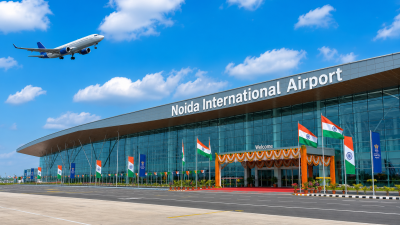
Noida International Airport Takes Off — IndiGo Operates First Commercial Flight to Amritsar

Noida International Airport officially entered India’s commercial aviation map on Sunday as IndiGo operated the first-ever scheduled flight from the facility — a service to Amritsar that marked the beginning of a new era for Delhi-NCR’s aviation infrastructure. The maiden departure, witnessed by aviation officials, government dignitaries, and excited passengers, transforms the long-awaited Jewar airport from an infrastructure promise into an operational reality.
The airport, located in Jewar in Uttar Pradesh’s Gautam Buddh Nagar district, becomes the second international airport serving the National Capital Region after Indira Gandhi International Airport (IGIA) in Delhi, and is expected to relieve mounting congestion at IGIA while catalysing economic development across western Uttar Pradesh and the broader NCR region.
Day One Operations
IndiGo, India’s largest airline by market share, launched three initial routes from Noida International Airport on the opening day: Amritsar, Bengaluru, and Hyderabad. The carrier plans to rapidly expand its network from the airport, with services to Jodhpur, Lucknow, Varanasi, Patna, and Jammu scheduled to begin within the next two weeks, and additional destinations including Bhopal, Chandigarh, Dehradun, Dharamshala, and Jaipur planned for July 1.
Akasa Air is set to begin operations from the airport the following day, with flights to Bengaluru and Navi Mumbai. Air India Express has also confirmed plans to launch services, making it at least three carriers operating from the new facility within its first week — a strong start that reflects airline confidence in the airport’s commercial viability.
The first phase of the airport features a single runway and a modern terminal building with an annual passenger handling capacity of approximately 12 million. The terminal design draws inspiration from the Yamuna River and the cultural heritage of the NCR region, with spacious check-in halls, state-of-the-art security screening, and an emphasis on natural light, energy efficiency, and passenger comfort.
Why Delhi-NCR Desperately Needed This Airport
The case for a second NCR airport has been building for over a decade. IGIA handled more than 73 million passengers in the last fiscal year, approaching its designed capacity of 80-90 million. The congestion has manifested in longer taxiing times, increased flight delays, crowded terminals, and growing resistance from surrounding residential areas to further expansion.
The shortage of landing and takeoff slots at IGIA has constrained airline growth, prevented the entry of new carriers on popular routes, and forced airlines to operate with sub-optimal scheduling. Budget carriers, in particular, have struggled to secure the slot allocations needed to build competitive networks from Delhi.
Noida International Airport addresses these constraints by providing significant additional capacity in a location strategically positioned near the fast-growing urban centres of Noida, Greater Noida, and the industrial corridors of western Uttar Pradesh. The airport’s catchment area includes an estimated 60 million people within a three-hour drive, making it one of the most commercially attractive greenfield airports globally.
Connectivity: The Make-or-Break Factor
One of the most critical factors determining the airport’s long-term success will be surface connectivity. Currently, the primary access route is via the Yamuna Expressway, which provides a direct road link from Noida and Greater Noida. The Delhi-Mumbai Expressway and Agra-Lucknow Expressway provide additional road connectivity from multiple directions.
Rail connectivity, which aviation experts consider essential for attracting passengers from central Delhi and other NCR cities, is being developed through the Noida Metro Airport Line. This metro extension will connect the airport to the broader Delhi Metro network, providing seamless public transport access. However, the metro link is not yet operational on day one — a limitation that may initially constrain passenger volumes.
The proposed Delhi-Varanasi high-speed rail corridor is also planned to include a station near the airport, potentially transforming it into a multi-modal transportation hub that connects air, rail, and road networks.
Economic Impact and Future Expansion
The Uttar Pradesh government has designated a large area around the airport as an aviation-linked industrial zone, designed to attract manufacturing, logistics, and service sector companies. An integrated multi-modal cargo hub is planned, targeting the growing demand for air freight driven by e-commerce, pharmaceuticals, and electronics manufacturing.
The airport’s master plan envisions expansion to four runways and an annual capacity of approximately 70 million passengers across multiple phases. The 5,000-acre site provides decades of scalable expansion potential, positioning the airport as a long-term solution to NCR’s aviation capacity needs.
As the first passengers streamed through the gleaming terminal on Sunday, Noida International Airport took its place in India’s rapidly expanding aviation landscape — a tangible symbol of the country’s infrastructure ambitions and a new gateway for one of the world’s most dynamic metropolitan regions.
Also Read
- Noida International Airport Set for Maiden Commercial Flight on June 15 — A New Chapter for Delhi-NCR Aviation
- Delhi Rains and Hailstorm Cause Chaos at IGI Airport: Over 500 Flights Delayed and 10 Cancelled on Tuesday
- SWISS Air Flight Engine Catches Fire During Takeoff at Delhi Airport: Six Passengers Injured in Emergency Evacuation of Airbus A330
- India Records Highest-Ever Power Demand as Heatwave Grips North — IMD Issues Orange Alert for Delhi on June 11
- Aviation Fuel Prices Rise 10% in India — Government Launches Price Stabilisation Scheme at Rs 115 Per Litre for Airlines