Bihar CM Samrat Choudhary Wins Floor Test as Nitish Kumar’s Two-Decade Era Ends: How BJP Engineered India’s Biggest Political Transition of 2026

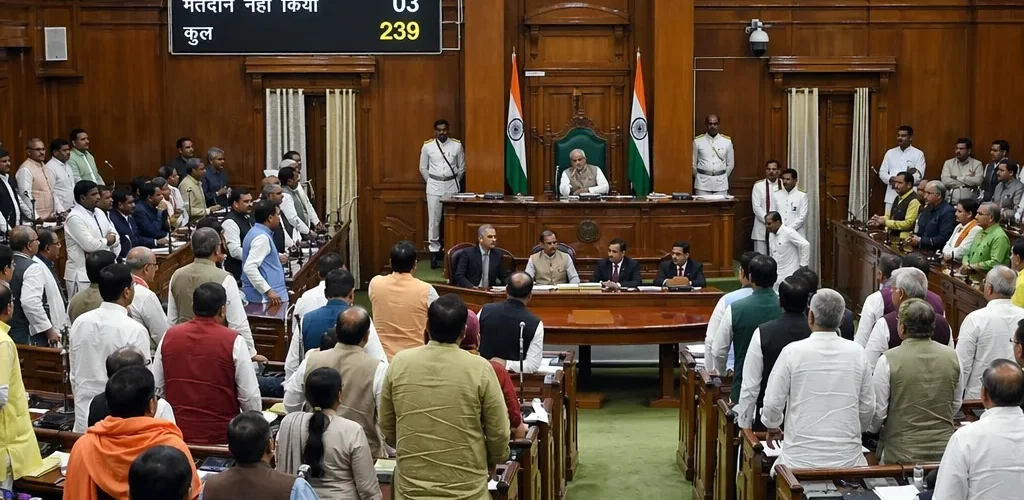
In a special session of the Bihar Vidhan Sabha on April 24, 2026, newly appointed Chief Minister Samrat Choudhary comfortably won the floor test that formally established the legitimacy of his BJP-led NDA government. With 201 NDA MLAs backing the new government in the 243-member Assembly (minus one vacant Bankipur seat), the outcome was never in doubt — but the political significance of the moment was immense. The floor test marks the official end of Nitish Kumar’s nearly two-decade dominance of Bihar politics and the beginning of a new chapter in which the BJP is firmly in the driver’s seat. RJD leader Tejashwi Yadav, speaking as Leader of the Opposition, used the session to deliver a blistering attack on the BJP, alleging that it had systematically “finished off” Nitish Kumar politically after using him to win elections.
The Floor Test: A Formality With Deep Significance
The floor test itself was procedurally straightforward. Bihar’s Governor had invited Samrat Choudhary to prove his majority on the floor of the Assembly following Nitish Kumar’s resignation as Chief Minister. The NDA’s strength in the Assembly — 201 MLAs comprising BJP, JD(U), HAM, and other allies — compared to the Opposition’s 41 MLAs, ensured the result was a foregone conclusion.
However, the session provided the stage for some of the most dramatic political exchanges Bihar has seen in years. The empty chair that Nitish Kumar once occupied, the sight of a BJP leader in the Chief Minister’s seat for the first time in Bihar’s modern political history, and Tejashwi Yadav’s pointed attacks on the ruling alliance combined to create a session that will be remembered as a watershed moment in the state’s political evolution.
Who Is Samrat Choudhary: Bihar’s First Dalit BJP Chief Minister
Samrat Choudhary’s appointment as Chief Minister carries enormous symbolic and political significance. A Dalit leader from the BJP, Choudhary represents the party’s strategic effort to expand its support base beyond its traditional upper-caste constituency in Bihar.
Choudhary, who previously served as Deputy Chief Minister in Nitish Kumar’s government, brings a reputation for administrative competence and loyalty to the BJP’s central leadership. His elevation was reportedly backed directly by the BJP high command, including Home Minister Amit Shah and PM Modi, who saw in him a leader capable of consolidating the Dalit and Extremely Backward Class (EBC) vote banks that are crucial for long-term electoral success in Bihar.
Political analysts note that Choudhary’s appointment is part of the BJP’s broader national strategy of elevating leaders from marginalised communities to chief ministerial and gubernatorial positions — a pattern visible in Madhya Pradesh, Chhattisgarh, and now Bihar.
How Nitish Kumar’s Reign Ended: The Inside Story
The story of Nitish Kumar’s departure is one of slow political erosion rather than sudden collapse. Despite leading the NDA to a decisive victory in the 2025 Bihar Assembly elections, Kumar’s position had been weakening for months as the BJP — which holds a commanding majority within the alliance — gradually asserted its dominance.
Kumar’s political brand had always rested on two pillars: his reputation for governance (“sushasan”) and his ability to navigate alliances. But his multiple switches between the NDA and the Opposition-led Mahagathbandhan — most recently rejoining the NDA in early 2024 after briefly aligning with RJD and Congress — had eroded his credibility as a reliable partner.
JD(U) insiders suggest that the final push came from the BJP central leadership, which concluded that Bihar needed a BJP face as Chief Minister to strengthen the party’s position ahead of the 2029 general elections. The transition was managed through internal negotiations rather than public confrontation, with Kumar reportedly stepping down after receiving assurances about his political legacy and the continued role of JD(U) in the alliance.
Tejashwi Yadav’s Blistering Attack: “BJP Finished Nitish Kumar”
The most memorable moments of the floor test session came from Tejashwi Yadav, who used his platform as Leader of the Opposition to deliver a withering critique of both the BJP and the circumstances of the leadership change.
“We knew that the BJP would not let Nitish Kumar remain the CM. The BJP kept saying that Nitish would be the NDA’s leader till 2030. But now they have finished him off,” Yadav declared on the Assembly floor.
He pointed out the irony of JD(U) leaders’ pre-election promises that Kumar would serve the full 2025-2030 term: “During the elections, we saw JD(U) leaders saying Nitish Kumar will be elected again in the 2025-2030 term. But we had already said that the BJP would not allow Nitish Kumar to remain in the chief minister’s chair, and that is exactly what happened.”
Yadav congratulated Choudhary on assuming office but questioned the legitimacy of a process in which “Bihar has seen five governments in five years,” suggesting that political instability has become Bihar’s defining feature.
The NDA’s Strategy: What Bihar Gets Under Choudhary
The new Choudhary government inherits both the challenges and the infrastructure of the Nitish Kumar era. Bihar remains one of India’s poorest states by per capita income, though economic indicators have improved significantly over the past two decades under Kumar’s governance.
Key priorities for the new government include accelerating industrial development, improving infrastructure connectivity — particularly the rail and road networks — addressing persistent issues of flood management and agricultural productivity, and managing the state’s relationship with the central government on issues including special status demands and fiscal transfers.
The BJP’s calculation is that a strong, loyal Chief Minister backed by central resources and political will can transform Bihar’s governance trajectory more effectively than a coalition arrangement where the chief ministerial chair belongs to a regional party with independent ambitions.
Impact on National Politics
The Bihar transition has immediate implications for national politics. Nitish Kumar’s departure removes one of India’s most experienced regional leaders from the executive arena, though he retains his position as JD(U) president and Rajya Sabha member. His political future — whether as a mentor figure within the NDA or as a potential power broker in future realignments — remains an open question.
For the Opposition INDIA alliance, the Bihar development is a setback insofar as it demonstrates the BJP’s ability to consolidate power within coalition governments. However, Tejashwi Yadav’s performance during the floor test session signals that the RJD intends to position itself as an aggressive and visible opposition force in the state.
The transition also sets the stage for the second phase of Bihar’s political battle — ensuring that the NDA’s governance delivers tangible results before the next electoral test. With the 2026 Census and delimitation process approaching, the stakes for Bihar’s political alignment could not be higher.
Bihar’s Political Rollercoaster: Five Governments in Five Years
Tejashwi Yadav’s observation about Bihar having “five governments in five years” reflects a period of extraordinary political turbulence. From the Mahagathbandhan experiment in 2022-2024, Nitish Kumar’s return to the NDA, the 2025 elections, and now the leadership transition to Choudhary — Bihar’s voters have witnessed more political upheaval than almost any other Indian state in this period.
For ordinary citizens, the question is whether the latest change will bring stability and development or simply mark another chapter in Bihar’s seemingly endless political drama. The floor test of April 24, 2026, has answered the constitutional question of legitimacy. The harder test — of governance, delivery, and public trust — has only just begun.