Enforcement Directorate Arrests Punjab Minister Sanjeev Arora in Rs 100 Crore GST Fraud Money Laundering Case as AAP Hits Out at Centre

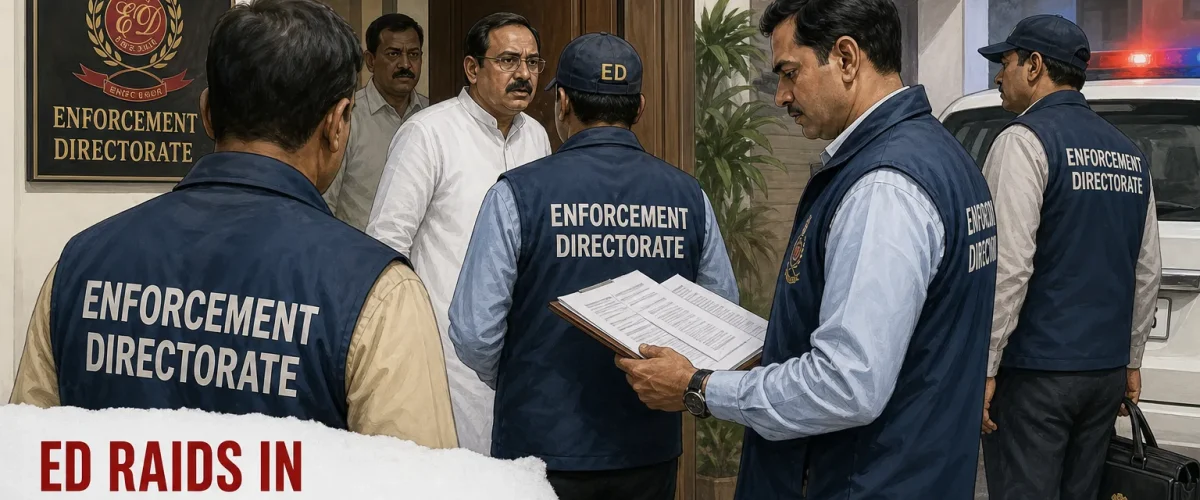
In a dramatic escalation of the Centre’s anti-corruption enforcement actions against state-level politicians, the Enforcement Directorate (ED) arrested Punjab Industries Minister Sanjeev Arora on Saturday, May 9, 2026, in connection with an alleged Rs 100 crore GST fraud-related money laundering case. The arrest came after early-morning raids at Arora’s official residence in Chandigarh, marking one of the most high-profile PMLA (Prevention of Money Laundering Act) arrests of a sitting state minister in recent years.
A special PMLA court in Gurugram subsequently granted a seven-day remand of the 62-year-old minister to the ED for custodial interrogation. The agency has argued that Arora was “non-cooperative” during the investigation and that custodial interrogation is necessary to unravel the full extent of the alleged money laundering network.
The Alleged GST Fraud Network
According to ED officials, the case centres on a network of shell companies and fictitious firms that are accused of generating fraudulent GST input tax credits worth over Rs 100 crore. The agency alleges that certain entities linked to Arora and his business associates created a web of fake invoices to claim tax credits on goods and services that were never actually supplied or received.
The modus operandi, as described in the ED’s complaint, involved the creation of dozens of non-existent firms registered across multiple states, including Punjab, Haryana, Delhi, and Rajasthan. These firms allegedly issued circular invoices to one another, creating the appearance of legitimate commercial transactions while generating fraudulent tax credits that were then monetised through various channels.
ED officials said that the proceeds of the fraud were laundered through layered transactions involving real estate purchases, shell company investments, and cash withdrawals. The agency claims to have identified properties and assets worth several crore that were allegedly acquired using the laundered funds.
“The investigation has revealed a sophisticated network designed to defraud the public exchequer,” an ED official said on condition of anonymity. “The minister’s role in facilitating and benefiting from this network is being examined in detail.”
AAP and Punjab Government Respond
The Aam Aadmi Party (AAP), which leads the Punjab government, reacted sharply to the arrest, accusing the Bharatiya Janata Party (BJP)-led central government of using federal agencies as political weapons. Punjab Chief Minister Bhagwant Mann called the arrest a “political conspiracy” and demanded Arora’s immediate release.
“This is nothing but vendetta politics,” Mann said in a press conference in Chandigarh. “The BJP cannot win elections in Punjab, so they use the ED, CBI, and other agencies to harass our ministers and destabilise our elected government. The people of Punjab see through this game.”
AAP’s national spokesperson added that the timing of the arrest — coming during a period of heightened security concerns in Punjab following recent incidents — was “suspicious and deliberately designed to divert attention from the Centre’s failures.”
The BJP, however, dismissed the allegations of political motivation. Party spokesperson Sambit Patra said: “The ED is an independent agency that follows the law. If a minister is involved in a Rs 100 crore fraud, they should face the consequences regardless of which party they belong to. AAP’s attempts to play victim are not convincing.”
Arora’s Political Journey and Business Background
Sanjeev Arora, 62, is a Rajya Sabha MP from Punjab who was inducted into the state cabinet as Industries Minister. Before entering politics, Arora was a prominent businessman in Ludhiana with interests in textiles, real estate, and manufacturing. He joined AAP ahead of the 2022 Punjab elections and was rewarded with a Rajya Sabha nomination, later being elevated to a cabinet position.
The arrest is not Arora’s first brush with legal proceedings. He has previously faced allegations related to land acquisition irregularities in Ludhiana, though those cases did not result in arrests. Political opponents have long questioned the source of his wealth, allegations that Arora has consistently denied.
The ED case is based on an FIR originally filed by the Directorate General of GST Intelligence (DGGI), which identified the shell company network during a broader investigation into GST fraud across northern India. The ED subsequently registered a money laundering case under the PMLA, which allows the agency to investigate the proceeds of certain predicate offences, including tax fraud.
Legal Implications and What Comes Next
The seven-day ED custody will be used to interrogate Arora about his knowledge of and involvement in the alleged network. The agency is expected to confront him with documentary evidence including bank statements, property records, and communications recovered during the raids.
Legal experts note that PMLA cases carry a reverse burden of proof, meaning that once the ED establishes a prima facie case of money laundering, the accused must demonstrate that the assets in question were acquired through legitimate means. This procedural feature makes PMLA cases particularly challenging for defendants.
The case also has implications for the broader economic landscape, as GST fraud continues to be a significant challenge for India’s tax administration. The government has estimated that fraudulent input tax credits cost the exchequer thousands of crore annually, undermining the GST system’s integrity and depriving the government of revenue needed for public services.
Meanwhile, the political fallout from the arrest is likely to intensify as Punjab gears up for municipal elections later this year. The BJP-AAP rivalry, already fierce after the recent developments in states like Bihar and West Bengal, is set to become even more contentious in the wake of this arrest.
The ED’s next step will be to file a formal prosecution complaint (equivalent to a charge sheet) and seek to attach properties it believes were acquired through the proceeds of crime. Arora’s legal team has announced plans to challenge the remand order in the Punjab and Haryana High Court, arguing that the arrest was procedurally flawed and politically motivated.
As the case unfolds, it adds to the growing list of sitting legislators and ministers facing federal agency investigations across party lines, raising fundamental questions about the intersection of politics, business, and law enforcement in contemporary India.

- Indian Army Gets New Chief as General Dwivedi Hands Over Command Amid Push for Indigenous Defence Tech - July 1, 2026
- Ayodhya Ram Temple Donation Scandal Deepens as Trustees Resign and SIT Arrests Eight - June 29, 2026
- Bengal Seven Weeks On: Modi’s Historic Win and the Questions That Won’t Go Away - June 28, 2026