Sensex Crashes Over 3000 Points in Four Days as IT Stocks Plunge and FII Selling Intensifies Amid Crude Oil Surge and Rupee Crisis


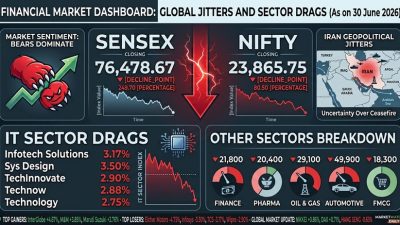
Indian stock markets extended their brutal sell-off on Tuesday, 12 May 2026, with the BSE Sensex crashing over 1,000 points in intraday trade — marking the fourth consecutive session of steep losses that have together erased more than 3,000 points and wiped out over Rs 6.4 lakh crore in investor wealth. The Nifty 50 fell below the 23,650 level as panic selling gripped the market, driven by a toxic combination of surging crude oil prices, a weakening rupee, relentless foreign institutional investor (FII) outflows, and escalating geopolitical uncertainty.
At 10:33 am IST, the Sensex was down 766.75 points or 1.01 per cent at 75,248.53, while the Nifty declined 207.50 points or 0.87 per cent to 23,608.35. Market breadth was decisively negative, with 2,367 shares declining against just 1,130 advances on the BSE. The total market capitalisation of BSE-listed companies slid to approximately Rs 460 lakh crore, down from over Rs 466 lakh crore at the start of the week.
IT Stocks Lead the Carnage
Information technology stocks emerged as the single biggest drag on the market on Tuesday, with the Nifty IT index plunging nearly 4 per cent in morning trade. TCS fell 4.44 per cent to become the top Nifty loser, while Infosys, HCL Technologies, Tech Mahindra, and Wipro all recorded declines exceeding 3 per cent. The top five Nifty losers were all from the IT sector, reflecting deepening concerns about the impact of a potential US economic slowdown on Indian technology companies’ revenue growth.
The IT sell-off was triggered by a combination of factors. The strengthening of the Indian rupee against the dollar in recent months had already begun to compress export revenue margins for IT companies. But the sharp reversal, with the rupee crashing 139 paise to Rs 94.90 against the dollar, paradoxically failed to support IT sentiment because it signalled broader economic instability rather than a margin-friendly depreciation.
In the broader market, the Nifty Midcap 100 index fell 0.83 per cent and the Smallcap 100 dropped 1.3 per cent, indicating that the sell-off was not limited to large-cap stocks. Among midcap losers, Persistent Systems declined 4.81 per cent, while JSW Infrastructure, Kaynes Technology, UPL, Relaxo Footwear, and KPIT Technologies also fell sharply.
FII Selling Shows No Signs of Stopping
Foreign portfolio investors (FPIs) have been the primary force behind the market decline, continuing their aggressive selling in May after withdrawing Rs 14,231 crore from Indian equities in just the first week of the month. Cumulative FPI outflows for calendar year 2026 have now crossed Rs 2 lakh crore, a figure that has rattled domestic market participants and raised questions about the sustainability of India’s premium valuations in a global environment of rising risk aversion.
Vikram Kasat, Head Advisory at PL Capital, attributed the continued FII selling to multiple factors: the elevated crude oil prices, uncertainty surrounding the US-Iran conflict, rising US Treasury yields as inflation expectations climbed globally, and the relative attractiveness of other emerging market destinations that have been less affected by the energy price shock.
Crude Oil Remains the Central Worry
Brent crude prices continued to trade above $105 per barrel on Tuesday, keeping pressure on oil-importing economies like India. The crude oil surge past $114 per barrel earlier in May and the subsequent volatility have created a persistent headwind for Indian markets. While oil and gas stocks bucked the trend on Tuesday — gaining on elevated crude prices — the broader negative impact on India’s current account deficit, fiscal balance, and inflationary outlook far outweighed any sectoral benefit.
The Iran war, now in its 11th week, continues to be the dominant geopolitical risk factor. US President Donald Trump’s description of the ceasefire as being “on life support” sent fresh shockwaves through global markets on Monday, reversing the brief optimism that had emerged after earlier diplomatic signals.
Banking and Financial Stocks Under Pressure
The Bank Nifty index also came under significant selling pressure, falling over 1 per cent as concerns about rising bond yields and potential loan quality deterioration weighed on sentiment. State Bank of India, ICICI Bank, and HDFC Bank — the three largest lenders by market capitalisation — all declined between 0.8 and 1.5 per cent.
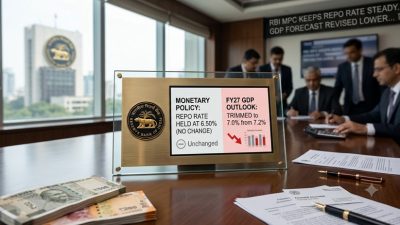
Analysts noted that the banking sector is particularly vulnerable to the current environment because rising crude oil prices feed through to higher inflation, which in turn constrains the Reserve Bank of India’s ability to cut interest rates further. The Sensex had already fallen over 450 points last Thursday, and the cumulative damage since then has shaken even the most optimistic market participants.
What Are Experts Saying?
Market strategists are divided on the near-term outlook. Some see the current sell-off as a buying opportunity, noting that India’s long-term growth story remains intact and that domestic economic indicators such as the services PMI and manufacturing PMI have remained robust. Others warn that the combination of geopolitical risk, currency weakness, and FII selling could push markets lower before a meaningful recovery materialises.
“We are in the middle of a perfect storm,” said Shankar Sharma, founder of GQuant Research. “Crude oil, the rupee, FII flows, and global uncertainty are all moving against India simultaneously. The market is repricing risk, and that process may not be over.” Meanwhile, retail investors — who had been a stabilising force during previous FII selling episodes — appear to be turning cautious as well. Mutual fund SIP flows, while still healthy at over Rs 25,000 crore per month, have shown signs of plateauing after months of record inflows.
For the Indian stock markets, the coming days will be crucial. The April CPI inflation data due later today, Bharti Airtel’s quarterly results on Thursday, and any developments in the US-Iran conflict will determine whether the sell-off deepens or whether buyers step in to arrest the decline. Until then, investors are advised to exercise caution and avoid leveraged positions in an environment where volatility remains elevated.