Super El Nino 2026 Threatens India Southwest Monsoon as IMD Forecasts Below-Normal Rainfall and Drought Risk Looms Over 60 Percent Farmers

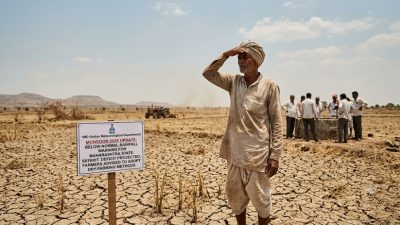
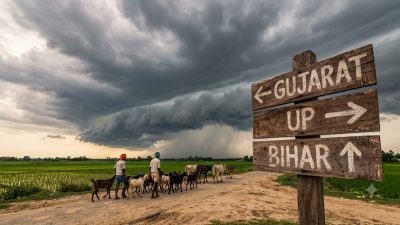
India’s agricultural heartland faces its most serious monsoon threat in a decade as the India Meteorological Department warns that the 2026 southwest monsoon season is likely to deliver below-normal rainfall, driven by a rapidly intensifying super El Niño event in the equatorial Pacific Ocean. The forecast, which projects total seasonal rainfall of approximately 800 millimetres against a long-period average of 870 mm, has sent alarm bells ringing across government ministries, farming communities, and commodity markets.
IMD’s Long-Range Forecast: The Numbers
The IMD’s long-range forecast, issued on 13 April 2026, paints a sobering picture for the June-to-September monsoon season. The probability of a deficient season, defined as rainfall below 90 per cent of the long-period average, stands at 35 per cent. This is more than double the long-term climatological probability of 16 per cent, indicating that the odds are heavily stacked against a normal monsoon year.
The chances of a below-normal season, with rainfall between 90 and 95 per cent of LPA, are 31 per cent. Together, the probability of either deficient or below-normal rainfall exceeds 66 per cent, leaving only a 27 per cent chance of normal rainfall and a combined 7 per cent chance of above-normal or excess precipitation.
These projections are consistent with the 2015-16 super El Niño, the last comparable event, when IMD predicted 93 per cent of LPA but actual rainfall came in at just 86 per cent, triggering widespread drought-like conditions across the country and forcing the government to declare drought in over 250 districts.
What Is a Super El Niño and Why Does It Matter?
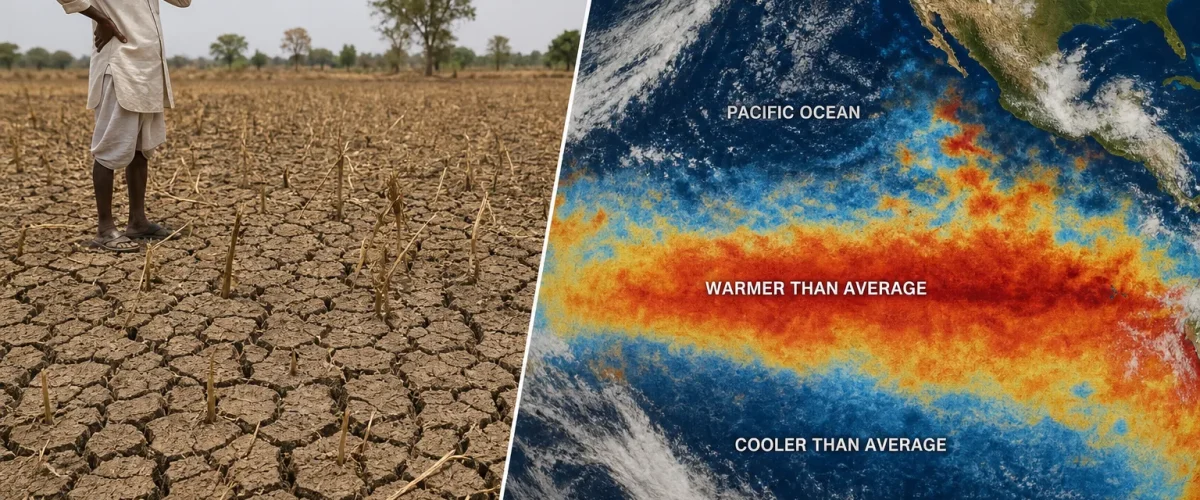
El Niño is a climate phenomenon characterised by abnormal warming of sea surface temperatures in the central and eastern equatorial Pacific Ocean. A super El Niño occurs when this warming exceeds 2 degrees Celsius above the average, significantly altering global weather patterns. The current event, which began developing in early 2026, has already pushed sea surface temperature anomalies above 2.1 degrees Celsius in the Niño 3.4 region.
For India, the El Niño connection to the monsoon is well-established. The warming of the Pacific suppresses the Walker circulation, weakens the cross-equatorial monsoon flow, and reduces moisture transport from the Indian Ocean to the subcontinent. Historically, 60 per cent of El Niño years have coincided with below-normal or deficient monsoon rainfall in India.
The southwest monsoon, which typically arrives over Kerala by 1 June and covers the entire country by mid-July, contributes approximately 70 per cent of India’s annual rainfall. The kharif agricultural season, which accounts for about 50 per cent of the country’s total foodgrain production, is almost entirely dependent on monsoon rains.
Impact on Agriculture and Food Security
An estimated 60 per cent of India’s 150 million farming households rely on monsoon rainfall for irrigation, making them acutely vulnerable to any shortfall in precipitation. The kharif season covers major crops including rice, maize, cotton, sugarcane, pulses, and oilseeds.
Agricultural economists at the National Bank for Agriculture and Rural Development (NABARD) estimate that a 10 per cent shortfall in monsoon rainfall could reduce kharif foodgrain output by 8 to 12 per cent, equivalent to a loss of approximately 15 to 20 million tonnes. Such a decline would push up food prices, particularly for rice and pulses, which are dietary staples for hundreds of millions of Indians.
“The combination of a potential super El Niño and the ongoing heatwave means that soil moisture levels are already depleted in many rain-fed agricultural districts. Even if the monsoon onset is on time, the total quantum of rainfall over the season could fall significantly short of crop water requirements,” said Dr Ashok Gulati, former chairman of the Commission for Agricultural Costs and Prices.
Government Preparedness and Contingency Plans
The Union Agriculture Ministry has activated its drought contingency framework, directing all state governments to prepare district-level drought management plans by 31 May. The National Disaster Management Authority has been asked to pre-position relief materials in the 150 most vulnerable districts, identified based on historical drought frequency and current groundwater levels.
The government has also announced an increase in the minimum support price for kharif crops, with a 5 per cent hike for paddy and a 7 per cent increase for pulses, in an effort to incentivise sowing despite the uncertain monsoon outlook. The Reserve Bank of India has been consulted on the potential inflationary impact, with economists warning that food inflation could breach 7 per cent by September if the monsoon underperforms.
Water Reservoirs and Groundwater Stress
India’s major reservoirs are already under stress heading into the monsoon season. According to the Central Water Commission, the 150 major reservoirs monitored across the country were at just 24 per cent of their total live storage capacity as of 15 May 2026, compared to 29 per cent at the same time last year and a 10-year average of 27 per cent.
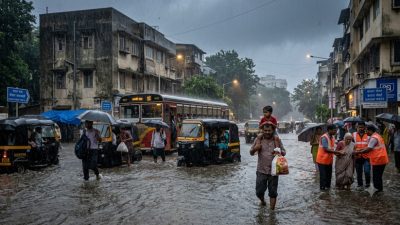
Groundwater levels in key agricultural states including Maharashtra, Karnataka, Madhya Pradesh, and Rajasthan have dropped to critical levels after two consecutive years of below-average post-monsoon recharge. The water crisis in cities like Mumbai, which has already imposed a 10 per cent supply cut, is a precursor to what could become a nationwide water emergency if the monsoon fails to deliver adequate recharge.
Historical Parallels and What They Tell Us
The last time India faced a super El Niño-driven monsoon deficit was in 2015-16. That year, 263 out of 677 districts were declared drought-affected, agricultural GDP contracted by 0.2 per cent, and rural distress contributed to a wave of farmer suicides that became a major political issue. The government was forced to import over 1.5 million tonnes of pulses to stabilise domestic prices.
Climate scientists point out that the 2026 situation could be more challenging than 2015 due to the compounding effect of the ongoing heatwave conditions, higher baseline water stress from urbanisation and industrial demand, and the disruption to energy markets caused by the West Asia conflict, which has pushed up the cost of diesel-powered irrigation.
“We are heading into the monsoon season with multiple vulnerabilities converging simultaneously. The El Niño is the primary driver, but the heatwave, low reservoir levels, and high energy costs create a perfect storm for rural India,” said Dr Roxy Mathew Koll, a climate scientist at the Indian Institute of Tropical Meteorology in Pune.
The IMD is expected to release its updated monsoon forecast with regional and monthly breakdowns by the end of May. For now, India’s farming communities and policymakers are watching the Pacific Ocean’s temperature gauges with growing anxiety, hoping that the monsoon will defy the odds as it has done in some past El Niño years, but preparing for the worst.

- Fentanyl Vaccine Breakthrough: Scripps Research Develops Shot That Blocks Deadly Overdoses Before They Reach the Brain - June 13, 2026
- Nipah Virus Returns to Kerala — First Case of 2026 Confirmed, State Declares High Alert - June 12, 2026
- Jill Biden Reveals She Wanted to Keep PM Modi’s 7.5-Carat Diamond Gift but Returned It After State Department Valued It at $20,000 - June 8, 2026