India-UK Free Trade Agreement Goes Live July 15: Steel Hurdle Cleared, 99% Exports Duty-Free

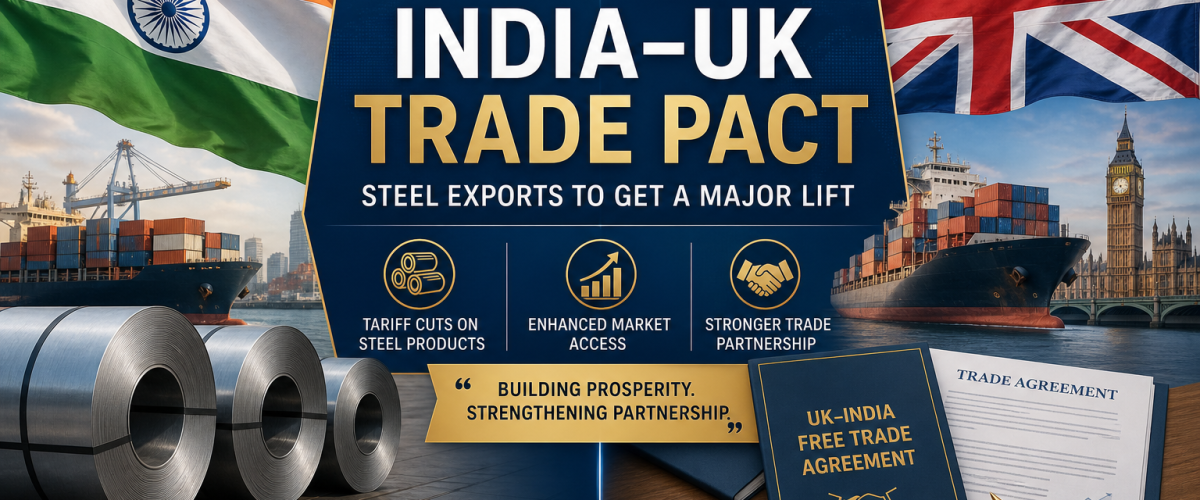
The India-UK Free Trade Agreement (FTA) has cleared its final major hurdle with a resolution of the contentious steel safeguard issue, paving the way for the agreement to go live on July 15, 2026. Under the deal, more than 99% of Indian exports will enter the United Kingdom at zero duty, making it one of the most comprehensive trade agreements India has concluded with a major developed economy.
The steel issue — which had threatened to delay the FTA’s operationalization — has been resolved with approximately 85% of India’s steel exports falling outside the scope of UK steel safeguard measures. The remaining 15%, comprising roughly $137 million across about 188 tariff lines, will be subject to country-specific quotas and other access schemes that mitigate the impact on Indian exporters.
What the FTA Delivers for India
The India-UK FTA is a landmark achievement in India’s trade diplomacy, delivering benefits across multiple sectors:
Duty-Free Access: Over 99% of Indian exports will enter the UK market at zero duty, providing a massive boost to sectors including textiles, engineering goods, manufacturing, leather products, and processed foods. For Indian exporters, this eliminates a significant cost barrier and makes Indian products more competitive in the UK market.
Steel Exports: The resolution of the steel safeguard issue ensures that the vast majority of India’s steel exports to the UK are unaffected by protective measures. India is a significant steel exporter, and the preservation of market access was a critical negotiating priority.
Services and Mobility: One of the FTA’s most significant provisions for India is the extension of social security benefits for Indian professionals in the UK from three to five years. This addresses a long-standing concern of India’s IT and services sector, providing greater stability and security for the hundreds of thousands of Indian professionals working in Britain.
Pharmaceutical and Healthcare: The agreement includes provisions for improved market access for Indian pharmaceutical products, building on India’s role as the “pharmacy of the world” and its strengths in generic drug manufacturing.
What the UK Gets
For the United Kingdom, the FTA opens access to one of the world’s largest and fastest-growing consumer markets. Key benefits include:
Services Sector: UK financial services, legal services, and professional services firms gain improved access to the Indian market, complementing Britain’s post-Brexit strategy of diversifying trade relationships beyond the European Union.
Whisky and Spirits: India has agreed to reduce tariffs on Scotch whisky and other UK spirits — a long-standing demand of British negotiators and a symbolic breakthrough given India’s position as one of the world’s largest whisky markets.
Technology and Innovation: The FTA includes provisions for technology cooperation, intellectual property protection, and digital trade that align with both countries’ ambitions to be leaders in the global knowledge economy.
The Steel Controversy Explained
The steel safeguard issue arose from the UK’s existing protective measures on steel imports, designed to prevent a surge of cheap steel from flooding the domestic market. India, as a major steel producer, was concerned that these safeguards would undermine the benefits of the FTA for its steel sector.
The resolution — which exempts 85% of Indian steel exports from safeguard measures and provides quotas for the remaining 15% — represents a pragmatic compromise that protects Indian exporters’ interests while maintaining the UK’s ability to manage its steel market. For India’s steel industry, the deal provides certainty and predictability that will support investment and export planning.
The July 15 Timeline
With the steel issue resolved, both countries have confirmed that the FTA will be operationalized on July 15, 2026. The legal ratification process has been completed, and administrative preparations — including customs procedures, tariff schedules, and dispute resolution mechanisms — are being finalised.
The India-UK FTA is India’s second major trade agreement of 2026, following the historic India-EU free trade deal concluded in January. Together, these agreements represent a fundamental shift in India’s trade strategy: from a historically protectionist stance to an increasingly open and engaged approach that leverages India’s market size and growth trajectory as bargaining chips in pursuit of strategic trade partnerships.
Also Read
- India-UK FTA: JLR Slashes Range Rover Prices by Up to Rs 75 Lakh as Free Trade Agreement Opens New Era for Luxury Car Market
- India and New Zealand Sign Historic Free Trade Agreement: Zero Tariffs on 57% of Exports, $20 Billion Investment Commitment and Preferential Access for Kiwifruit and Apples
- India-US Trade Deal Explained: How the Historic 18 Per Cent Tariff Agreement and $500 Billion Commitment Affect Indian Consumers and Businesses
- Axiom Mission 4: Indian Astronaut Subhanshu Shukla Completes Historic 14-Day Stay on International Space Station
- India to Send Bengal Tigers to Cambodia in First Ever Cross-Border Tiger Translocation Under 2022 Bilateral Agreement