India and New Zealand Sign Historic Free Trade Agreement: Zero Tariffs on 57% of Exports, $20 Billion Investment Commitment and Preferential Access for Kiwifruit and Apples

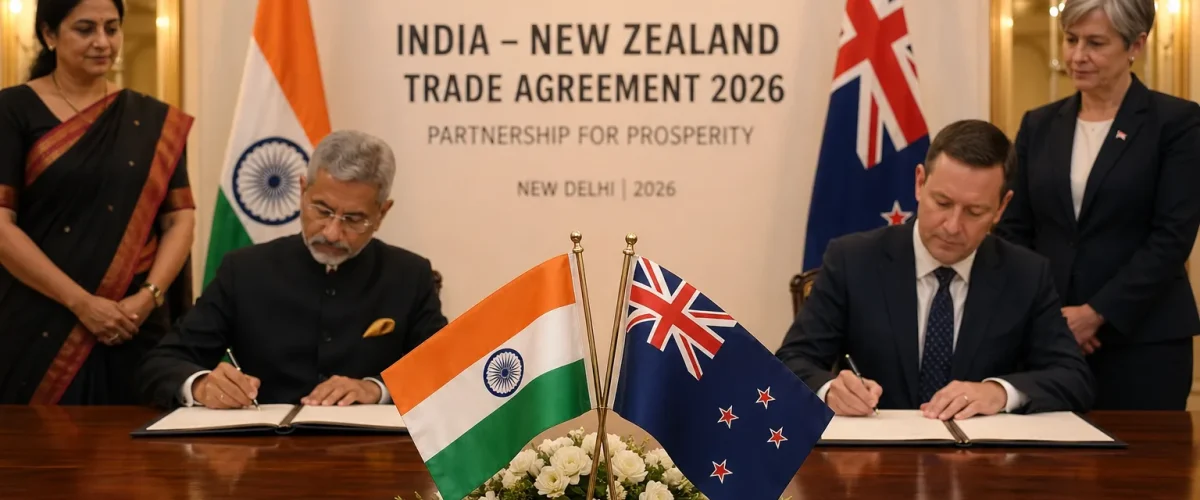
India and New Zealand signed a landmark Free Trade Agreement (FTA) in New Delhi on Sunday, 27 April 2026, marking the culmination of over a decade of negotiations between the two nations. The agreement, widely regarded as one of the most significant trade pacts India has concluded in recent years, will provide tariff-free access for 57 per cent of New Zealand’s current exports to India from day one, rising to 82 per cent over time, while opening up the large and fast-growing Indian market to a range of New Zealand products including forestry, sheep meat, wool, seafood, kiwifruit, and apples.
New Zealand Prime Minister Christopher Luxon, who was in India for the signing ceremony, described the deal as a “once-in-a-generation” achievement that would transform economic relations between the two countries. India’s Commerce Minister confirmed that the FTA includes a $20 billion investment commitment and provisions for professional visas, marking a deepening of the bilateral relationship that goes well beyond traditional trade.
Key Provisions of the India-New Zealand FTA
The Free Trade Agreement covers 95 per cent of New Zealand’s current exports to India, making it one of the most comprehensive trade deals either country has signed. The agreement is structured with immediate tariff elimination on a wide range of products, phased reductions over seven to ten years for sensitive categories, and preferential quotas for agricultural products where full liberalisation was not feasible.
Among the most notable provisions, over 95 per cent of New Zealand’s forestry exports — which constitute a major share of bilateral trade — will enter India tariff-free immediately upon the agreement coming into force. Tariffs on sheep meat, wool, coal, and many other products will also be removed on day one. For fish and seafood, tariffs on New Zealand’s key exports will be phased out over a seven-year period.
The agreement breaks new ground in horticulture. New Zealand has secured preferential access for kiwifruit and apples in India — a first in any Indian FTA. Kiwifruit will receive tariff-free access under a quota system, with volumes starting above average recent trade levels and growing beyond that. A 50 per cent tariff reduction will apply to kiwifruit traded outside the quota. For apples, New Zealand is the first country to secure preferential access in any Indian FTA, a significant achievement given India’s traditionally protective stance on apple imports.
Agricultural Sensitivities and Dairy Provisions
Agriculture has historically been the most contentious aspect of India-New Zealand trade negotiations. India’s dairy sector — the world’s largest, supporting over 80 million rural households — was a particular point of sensitivity. The final agreement reflects careful balancing of interests. While tariffs on bulk infant formula and other dairy-based preparations will be reduced, India has maintained protective measures on liquid milk and butter to safeguard domestic dairy farmers.
Other agricultural products covered by the agreement include cherries, avocados, blueberries, and persimmons, all of which will see phased tariff elimination. Tariffs on New Zealand wine will be reduced by 66 to 83 per cent over ten years, with a most-favoured-nation clause ensuring New Zealand benefits from any better terms offered to future FTA partners. Manuka honey — a premium New Zealand export — will see tariffs cut by 75 per cent over five years, making New Zealand the first country to secure preferential access for honey in any Indian FTA.
Indian exporters stand to benefit significantly as well. The agreement provides preferential access for Indian textiles, garments, leather goods, pharmaceuticals, gems and jewellery, and IT services into the New Zealand market. Services trade is expected to grow substantially under the agreement, with provisions for mutual recognition of professional qualifications in engineering, architecture, and accounting.
Investment and Professional Mobility
Beyond goods trade, the FTA includes a comprehensive investment chapter and provisions for enhanced professional mobility. The $20 billion investment commitment — to be realised over a ten-year period — encompasses infrastructure, technology, agriculture, and green energy sectors. New Zealand has committed to facilitating Indian investment in its technology and education sectors, while India has signalled openness to New Zealand investment in food processing, cold chain logistics, and sustainable agriculture.
The agreement also includes provisions for professional visas, allowing skilled workers from both countries to work across borders more easily. This is expected to benefit India’s large pool of IT professionals and engineers, many of whom already have strong ties with New Zealand’s growing technology sector. Education cooperation — including mutual recognition of degrees and joint research initiatives — forms another pillar of the agreement.
Strategic Significance in a Changing Global Trade Landscape
The India-New Zealand FTA comes at a time of significant upheaval in global trade. With the ongoing US-Iran conflict disrupting energy supply chains through the Strait of Hormuz, and trade tensions between the United States and China reshaping global commerce, both India and New Zealand see diversification of trade partnerships as strategically important.
For India, the agreement represents a deepening of ties with a key Indo-Pacific partner and complements its recent trade deal with the United States. For New Zealand, access to India’s market of 1.4 billion consumers is transformative — India is projected to become the world’s third-largest economy by 2028, and early preferential access could give New Zealand exporters a significant first-mover advantage.
Bilateral trade between India and New Zealand currently stands at approximately NZ$3.95 billion annually. Both governments expect this to grow substantially following the FTA’s implementation, with some analysts projecting bilateral trade could double within five years. The agreement will enter into force after both countries complete their domestic ratification processes, which is expected by the end of 2026.

- Fentanyl Vaccine Breakthrough: Scripps Research Develops Shot That Blocks Deadly Overdoses Before They Reach the Brain - June 13, 2026
- Nipah Virus Returns to Kerala — First Case of 2026 Confirmed, State Declares High Alert - June 12, 2026
- Jill Biden Reveals She Wanted to Keep PM Modi’s 7.5-Carat Diamond Gift but Returned It After State Department Valued It at $20,000 - June 8, 2026