India to Host BRICS Security Advisers’ Meet: Ajit Doval Chairs June 22-23 Talks on Cyber Threats

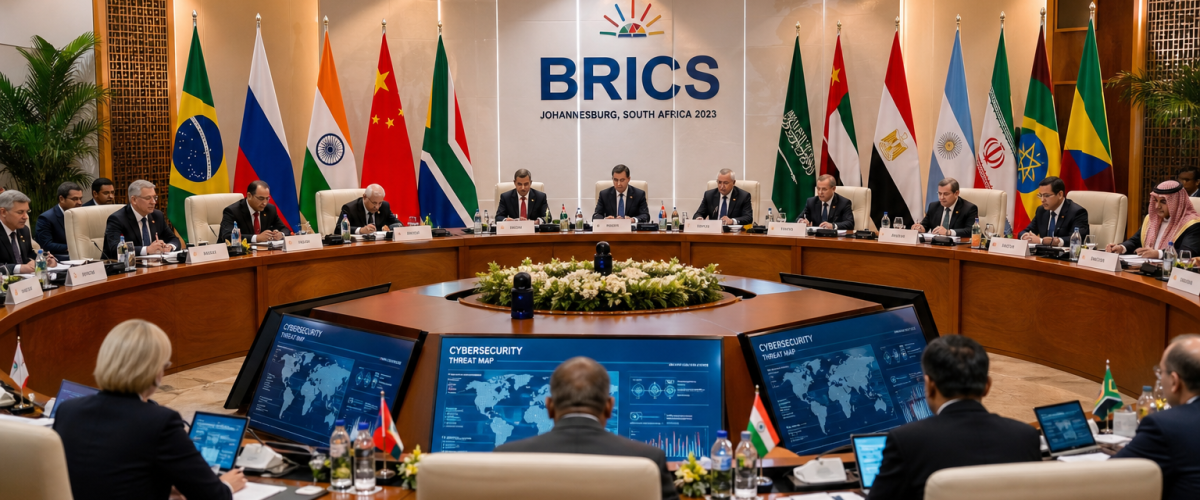
India will host the BRICS National Security Advisers’ (NSA) Meeting on June 22-23, 2026, with National Security Adviser Ajit Doval chairing discussions that will centre on non-traditional security challenges, including cyber threats, terrorism, and the security implications of emerging technologies. The Ministry of External Affairs (MEA) confirmed the meeting on Saturday, describing it as a critical forum for the ten-member grouping to coordinate responses to rapidly evolving security landscapes.
The NSA-level meeting — one of the most significant under India’s 2026 BRICS Chairship — brings together the national security chiefs of all BRICS member nations, including founding members Brazil, Russia, China, and South Africa, as well as newer entrants Iran, Saudi Arabia, UAE, Egypt, and Ethiopia. The expanded membership makes this the most geopolitically diverse security dialogue that India has ever hosted.
The Agenda: Non-Traditional Security
The meeting’s stated theme — “Non-traditional security challenges confronting the world today” — reflects India’s strategic framing of the BRICS security dialogue. By focusing on non-traditional threats rather than conventional military security, India is navigating the diplomatic challenge of hosting a forum that includes nations with sharply divergent geopolitical positions:
Cyber Threats: The rapid proliferation of state-sponsored and non-state cyber attacks has made cybersecurity one of the most urgent security challenges globally. The BRICS NSAs will discuss coordinated responses to critical infrastructure attacks, ransomware threats, and the use of AI in cyber warfare.
Counter-Terrorism: The meeting will review the outcomes of recently held BRICS Joint Working Groups on Counter-Terrorism, assessing progress on intelligence-sharing frameworks, counter-radicalisation strategies, and the financing of terrorist organisations.
Technology and Security: The intersection of emerging technologies — including AI, quantum computing, and autonomous weapons — with national security is a relatively new addition to the BRICS agenda, reflecting the growing consensus among member states that technology governance is fundamentally a security issue.
India’s Strategic Positioning
For India, the BRICS NSA meeting is an opportunity to demonstrate leadership in multilateral security diplomacy while advancing its own strategic priorities:
Related: Singapore Blocks 14 Anti-Indian Social Media Posts Likely Originating From China-Based Platform
Balancing Act: India’s BRICS Chairship requires managing the divergent interests of members that include both Western-aligned nations (Brazil, to some extent) and countries under Western sanctions (Russia, Iran). The non-traditional security focus allows India to build consensus on issues where all members share common concerns, avoiding the divisive debates that would accompany discussions of the Ukraine conflict, the Middle East, or US-China competition.
Cyber Leadership: India has been building its cybersecurity credentials through initiatives like the National Cyber Security Strategy, the Indian Cyber Crime Coordination Centre, and participation in global cybersecurity forums. Hosting the BRICS cyber discussions positions India as a thought leader in the global south’s approach to digital security.
Counter-Terrorism Credentials: India’s long experience with cross-border terrorism and its sophisticated counter-terrorism infrastructure give it credibility as a convener of multilateral counter-terrorism discussions.
The Russia-China Dynamic
The meeting’s most significant diplomatic undercurrent is the presence of both Russian and Chinese national security chiefs at a forum chaired by India. The Russia-China relationship within BRICS has been a source of both strength and tension for the grouping, and India’s ability to manage this dynamic will be closely watched.
Russia’s participation comes against the backdrop of the ongoing Ukraine conflict and the G7’s Évian communiqué, which explicitly targeted Russian assets and Chinese economic practices. China’s participation carries the weight of its unresolved border tensions with India and its growing assertiveness in the Indo-Pacific.
What to Watch
The outcomes of the June 22-23 meeting will be significant for several reasons: the joint statement’s language on cyber norms, counter-terrorism cooperation frameworks, and the degree to which BRICS can present a unified position on technology governance. For India, a successful meeting strengthens its multilateral credentials and advances its case for permanent membership of the UN Security Council — a long-standing diplomatic objective that BRICS support could help advance.
Also Read
- US-Iran MOU Explained: What the Framework Deal Covers and Why It Matters for India’s Energy Security
- G7 Évian Communiqué: Leaders Reaffirm Ukraine Support, Push Back on Russia and China
- India-France Adopt Innovation Roadmap 2030 and Launch New Economic Security Dialogue
- Jaishankar Hits Back at European Criticism of India’s Russia Policy — ‘European Weapons Have Been Used Against India’
- BRICS Agriculture Ministers to Meet in Indore — Five-Day Summit to Focus on Food Security, Smart Farming and AI in Agriculture

- Indian Army Gets New Chief as General Dwivedi Hands Over Command Amid Push for Indigenous Defence Tech - July 1, 2026
- Ayodhya Ram Temple Donation Scandal Deepens as Trustees Resign and SIT Arrests Eight - June 29, 2026
- Bengal Seven Weeks On: Modi’s Historic Win and the Questions That Won’t Go Away - June 28, 2026