G7 Évian Communiqué: Leaders Reaffirm Ukraine Support, Push Back on Russia and China

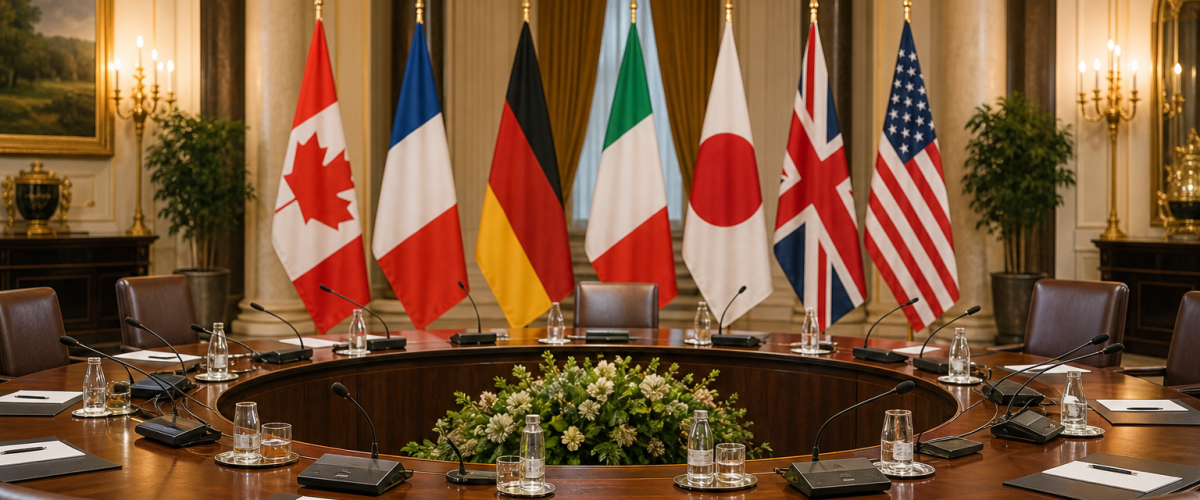
The G7 summit in Évian-les-Bains, France concluded this week with a comprehensive communiqué that reaffirmed the group’s unwavering support for Ukraine, intensified pressure on Russia through frozen asset mechanisms, and took aim at China’s economic practices — particularly industrial overcapacity and market-distorting subsidies. The document, running to dozens of pages, also addressed AI governance, critical minerals, climate change, and global health, making it one of the most wide-ranging G7 statements in recent years.
For India — which participated as a guest nation at the invitation of French President Emmanuel Macron — the communiqué’s language on China, Russia, and global economic governance carries significant diplomatic implications, reinforcing the balancing act that New Delhi must navigate between its Western partnerships and its relationships with Beijing and Moscow.
Ukraine: Sustained Commitment
The Ukraine section of the communiqué represents the most forceful collective statement of G7 support since the war began in 2022. Key elements include:
Frozen Russian Assets: Building on the $50 billion loan package backed by profits from frozen Russian assets agreed at the 2024 G7 summit, the Évian communiqué establishes mechanisms for potentially using the principal of the approximately $300 billion in frozen Russian sovereign assets — not just the interest — for Ukraine’s reconstruction. This represents a significant escalation from previous positions and has drawn sharp criticism from Russia.
Military Support: G7 leaders committed to sustaining and expanding military assistance to Ukraine, including advanced weapons systems, air defence capabilities, and training programmes. The language explicitly states that support will continue “for as long as it takes” — a formula designed to signal to Russia that the costs of the war will only increase.
Peace Framework: While supporting Ukraine’s territorial integrity, the communiqué also references the need for a “just and lasting peace” — language that some analysts interpret as leaving room for eventual negotiations, even if the G7’s public position remains maximalist.
China: Economic Pushback
The communiqué’s language on China, while carefully calibrated to avoid a direct confrontation, represents the G7’s most coordinated pushback against Chinese economic practices:
Industrial Overcapacity: French President Macron made the reduction of global economic imbalances a priority for France’s G7 presidency, and the communiqué reflects this emphasis. It calls out industrial overcapacity — widely understood as a reference to China’s subsidised manufacturing in sectors including steel, solar panels, and electric vehicles — as a threat to global economic stability.
Critical Minerals: The communiqué’s critical minerals initiative — including coordinated stockpiling and an IEA platform — is explicitly designed to reduce dependence on Chinese mineral processing. China controls 60-90% of global processing capacity for several critical minerals, and the G7 views this concentration as a strategic vulnerability.
Trade Practices: The statement references “non-market policies and practices” that distort global trade — standard diplomatic language for Chinese state subsidies, forced technology transfer, and market access restrictions. The G7 commits to coordinated action to address these practices, though the specific mechanisms remain to be developed.
AI Governance
The Évian communiqué advances the G7’s AI governance framework, building on the Hiroshima AI Process launched in 2023. The inclusion of major AI CEOs at the summit — Sam Altman, Dario Amodei, Demis Hassabis, and others — lent the AI discussions an urgency and practical grounding that previous G7 AI statements lacked. Key commitments include enhanced cooperation on AI safety testing, children’s protection in AI-generated content, and the development of shared standards for frontier AI models.
India’s Position
India’s participation at the G7 — though as a guest rather than a member — underscores the country’s growing geopolitical significance. PM Modi used the summit to advance India’s technology positioning (through VivaTech), its bilateral relationships (through meetings with Macron and other leaders), and its multilateral credentials (through engagement on AI governance and critical minerals).
However, the communiqué’s strong language on Russia and China creates diplomatic complexity for India. New Delhi has maintained its stance of strategic autonomy, engaging with both Russia (on energy and defence) and China (on trade and border management) while deepening its partnerships with the G7 nations. The Évian communiqué’s hardening positions on both Russia and China may increase pressure on India to clarify its alignments — a pressure that Indian diplomacy has so far managed with notable skill.
Also Read
- G7 Launches Critical Minerals Push: Coordinated Stockpiling to Cut China Dependency by 2030
- G7 AI Summit: Sam Altman, Dario Amodei, Demis Hassabis Join World Leaders for Landmark Lunch in Évian
- India-France Adopt Innovation Roadmap 2030 and Launch New Economic Security Dialogue
- G7 Summit Final Day: Modi-Trump Bilateral in Évian — Trade, Defence and Iran on the Table
- G7 Summit 2026 Opens in Évian-les-Bains — PM Modi Joins World Leaders, Trump Bilateral Expected

- Indian Army Gets New Chief as General Dwivedi Hands Over Command Amid Push for Indigenous Defence Tech - July 1, 2026
- Ayodhya Ram Temple Donation Scandal Deepens as Trustees Resign and SIT Arrests Eight - June 29, 2026
- Bengal Seven Weeks On: Modi’s Historic Win and the Questions That Won’t Go Away - June 28, 2026