Shashi Tharoor Backs PM Modi on Indian Sailors’ Safety at G7; BJP Says ‘Rahul Gandhi Exposed’

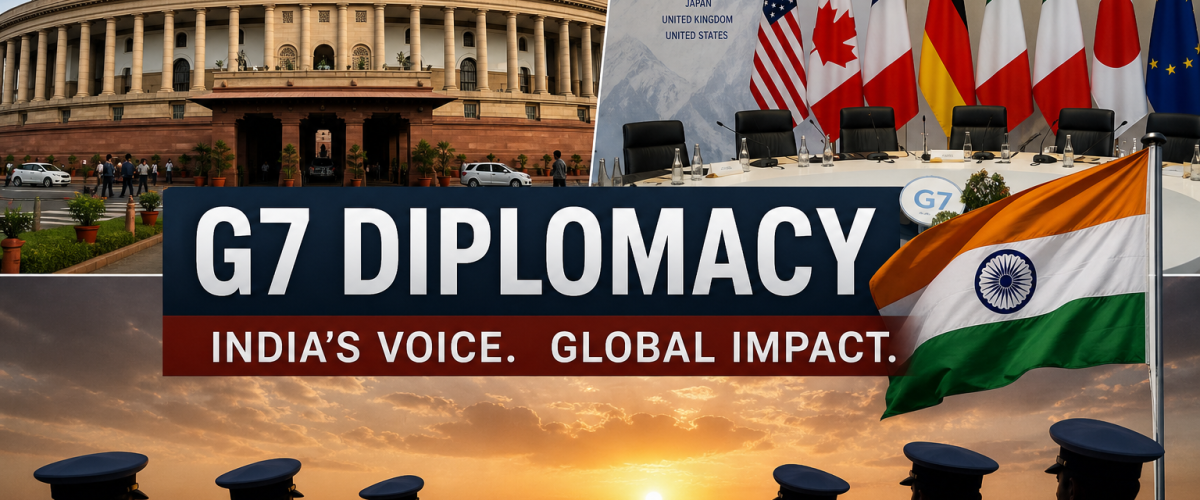
Congress MP Shashi Tharoor has once again broken ranks with his party’s official line by publicly backing Prime Minister Narendra Modi’s efforts to raise the issue of Indian sailors’ safety in Middle East conflict zones during his bilateral meeting with US President Donald Trump at the G7 summit. Tharoor’s endorsement has given the BJP fresh ammunition to attack Congress President Rahul Gandhi, with ruling party leaders declaring that Tharoor’s position “exposes” the opposition’s criticism of the PM as politically motivated.
The episode highlights one of Indian politics’ most persistent dynamics: the tension between Tharoor’s independent foreign policy views and the Congress party’s need for unified messaging against the Modi government.
What Tharoor Said
Speaking on the bilateral meeting between PM Modi and President Trump on the sidelines of the G7 summit in Évian, Tharoor said that the Prime Minister “conveyed India’s concerns to US President Trump regarding the safety of civilian sailors amid the ongoing conflicts” and stressed that “commercial seafarers should not become targets during wartime.”
Tharoor’s endorsement was significant because his party — the Congress — had been attacking PM Modi for allegedly being “silent” on the issue of Indian sailors trapped in conflict zones during his meeting with Trump. By publicly supporting the PM’s position, Tharoor effectively contradicted the Congress leadership’s narrative.
This is not the first time Tharoor has deviated from the Congress line on foreign policy matters. The Thiruvananthapuram MP has consistently maintained positions that are closer to India’s strategic consensus than to the opposition’s political messaging, earning him respect among foreign policy analysts but occasional friction within his own party.
The BJP’s Response
The BJP moved quickly to weaponise Tharoor’s statement against Rahul Gandhi. “When even a senior Congress MP like Shashi Tharoor acknowledges that PM Modi raised India’s concerns about sailors’ safety, it completely exposes Rahul Gandhi’s baseless allegations,” a BJP spokesperson said.
Related: G7 Évian Communiqué: Leaders Reaffirm Ukraine Support, Push Back on Russia and China
The ruling party’s strategy is clear: by amplifying Tharoor’s endorsement, the BJP aims to portray the Congress’s criticism of PM Modi’s G7 performance as motivated by political opposition rather than genuine policy concerns. The contrast between Tharoor’s nuanced appreciation of the PM’s diplomacy and the Congress leadership’s blanket criticism serves the BJP’s narrative perfectly.
The Sailors’ Issue
The underlying issue — the safety of Indian commercial seafarers in Middle East conflict zones — is genuinely serious. India has one of the world’s largest merchant marine workforces, with hundreds of thousands of Indian sailors employed on commercial vessels that transit through the Persian Gulf, the Red Sea, and other areas affected by the US-Iran conflict and Yemen’s Houthi attacks on shipping.
Several Indian-crewed vessels have been affected by the regional conflict, with crews facing risks ranging from missile attacks to detention. The PM’s decision to raise this issue with President Trump at the G7 was substantively appropriate — the US Navy’s operations in the region directly affect the security environment for commercial shipping.
Congress’s Dilemma
The Tharoor episode illustrates a recurring challenge for the Congress party: how to maintain a credible opposition voice on foreign policy without appearing to undermine India’s national interests. When senior party members like Tharoor publicly support the government’s diplomatic positions, it creates an awkward dynamic that the BJP exploits relentlessly.
The Congress leadership faces a choice: it can discipline Tharoor for deviating from the party line (which risks losing one of its most articulate and internationally respected voices), or it can tolerate the dissent (which provides the BJP with regular political ammunition). Neither option is comfortable.
The Bigger Picture
Beyond the partisan politics, the episode raises a legitimate question about the role of opposition parties in India’s foreign policy discourse. In most mature democracies, foreign policy enjoys a degree of bipartisan consensus — the principle that domestic politics stops at the water’s edge. India’s opposition parties have historically struggled with this balance, torn between the need to hold the government accountable and the imperative to project national unity on matters of international diplomacy.
Tharoor’s position — supporting the PM’s diplomatic engagement while maintaining the right to criticise domestic governance — offers a model for constructive opposition. Whether the Congress party will adopt it is another matter entirely.
Also Read
- G7 Summit Final Day: Modi-Trump Bilateral in Évian — Trade, Defence and Iran on the Table
- G7 Summit 2026 Opens in Évian-les-Bains — PM Modi Joins World Leaders, Trump Bilateral Expected
- Donald Trump Congratulates PM Modi on BJP’s Historic and Decisive West Bengal Election Victory
- Trump Praises Modi as ‘Good Friend’ and Says US Will Finalise Trade Deal with India Soon After Reversing Years of Trade Imbalance
- Punjab Municipal Election Results 2026 — AAP Sweeps Civic Polls with 131+ Seats as Congress, SAD and BJP Trail Far Behind