‘Foreign Degree Is ₹1 Crore Debt’: Is Studying Abroad Still Worth It for Indian Students in 2026?

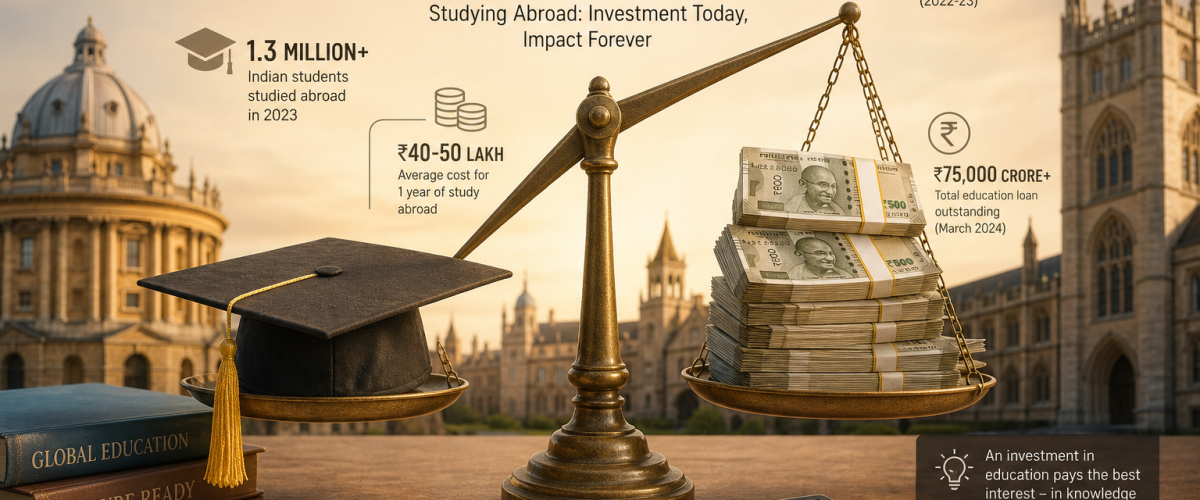
A provocative question has taken over Indian social media and dinner-table conversations this week: is a foreign university degree still worth the investment when it increasingly means taking on ₹1 crore or more in debt? The debate, sparked by a widely-shared NDTV analysis headlined “Foreign Degree Is Rs 1 Crore Debt”, has forced Indian families to confront uncomfortable truths about the economics of international education in 2026 — a year when a weaker rupee, surging tuition fees, and uncertain global job markets have fundamentally altered the cost-benefit calculus.
The numbers are stark. The average cost of a postgraduate degree at a top US or UK university — including tuition, living expenses, visa costs, and travel — now ranges from ₹40 lakh to ₹60 lakh per year. A two-year master’s programme can easily cross ₹1 crore in total outlay, much of which is financed through education loans at interest rates of 10-12% for unsecured borrowing.
What’s Changed
Several factors have converged to make studying abroad significantly more expensive for Indian students in 2026:
Rupee Depreciation: The Indian rupee’s decline against the US dollar and British pound has been one of the most consequential economic trends affecting Indian families with international education aspirations. When tuition and living costs are denominated in foreign currencies, even modest rupee depreciation translates into lakhs of additional expenditure over a degree programme.
Related: India Salary Appraisals Average 9 Per Cent in 2026, Highest Among Major World Economies: Aon Report
Tuition Inflation: International student fees at major Western universities have increased at rates significantly above general inflation. UK universities, in particular, have raised fees for international students aggressively — partly to compensate for domestic fee caps and partly because of strong demand from Asian students willing to pay premium prices.
Post-Study Work Uncertainty: The job markets that international students depend on for return on investment — particularly the US H-1B visa pathway and the UK Graduate Route — face political and policy uncertainty. Visa restrictions, preference for domestic hiring, and AI-driven job displacement in sectors that traditionally absorbed Indian graduates (IT, consulting, finance) have made the post-graduation employment picture murkier.
The ROI Question
The fundamental question for Indian families is whether the return on investment justifies the cost. The answer depends on several variables:
Related: Rising Oil Prices and Weak Rupee Pose Double Threat to India’s Economy as Iran Crisis Persists
For Top-Tier Programmes: A degree from a globally recognised institution — the Ivy League, Oxbridge, top European schools — continues to offer strong ROI through higher starting salaries, global career mobility, and networking opportunities. The average starting salary for an MBA graduate from a top-20 US programme exceeds $150,000 (approximately ₹1.3 crore), which makes even a ₹1 crore investment recoverable within a few years.
For Mid-Tier Programmes: The economics become significantly more challenging for programmes outside the top tier. Starting salaries for graduates of non-elite programmes may not differ dramatically from what top Indian institutions offer, while the cost premium is enormous. This is the segment where the ₹1 crore debt risk is most acute.
The Indian Alternative: India’s own higher education ecosystem has improved dramatically. IITs, IIMs, ISB, and other premier institutions now offer programmes that are globally competitive at a fraction of the cost. The rise of India’s startup ecosystem, the growth of multinational operations in India, and the increasing global recognition of Indian degrees have made the domestic option more attractive than ever.
The Human Dimension
Beyond the financial analysis, studying abroad offers intangible benefits — exposure to diverse perspectives, independence, cultural competence, and personal growth — that are difficult to quantify but genuinely valuable. For many Indian students, the international education experience is transformative in ways that go beyond career outcomes.
However, these intangible benefits must be weighed against the very tangible stress of ₹1 crore in debt — a burden that can constrain career choices (forcing graduates into high-paying but unfulfilling jobs to service loans), delay major life decisions (marriage, homeownership, family planning), and create financial anxiety that persists for years after graduation.
The Verdict
The honest answer is that studying abroad in 2026 is still worth it — but only under specific conditions: admission to a top-tier programme, realistic employment expectations, a family financial position that can absorb the risk, and a clear understanding that the investment is a bet on a global career rather than a guaranteed return. For everyone else, India’s own institutions offer a compelling and far less risky alternative.
Also Read
- Cockroach Janta Party Founder Abhijeet Dipke to Return to India on June 6 for Jantar Mantar Education Protest
- Indian Rupee Crashes to Record Low of 96.35 Against US Dollar Amid West Asia Crisis
- CBSE Makes Three Languages Mandatory for Class 9 and 10 From July 2026 Under National Education Policy as Two Must Be Native Indian Languages
- Indian Rupee Crashes 139 Paise to 94.90 Against US Dollar as Crude Oil Surges and Trump Rejects Iran Ceasefire Proposal
- Indian Rupee Plunges to Record Low of 95.5 Against US Dollar as Crude Oil Surge and Iran Tensions Weigh on Markets