CNG Price Crosses Rs 80 Per Kg in Delhi After IGL Hikes Rate by Re 1 for Second Time in 48 Hours Amid Global Energy Crisis

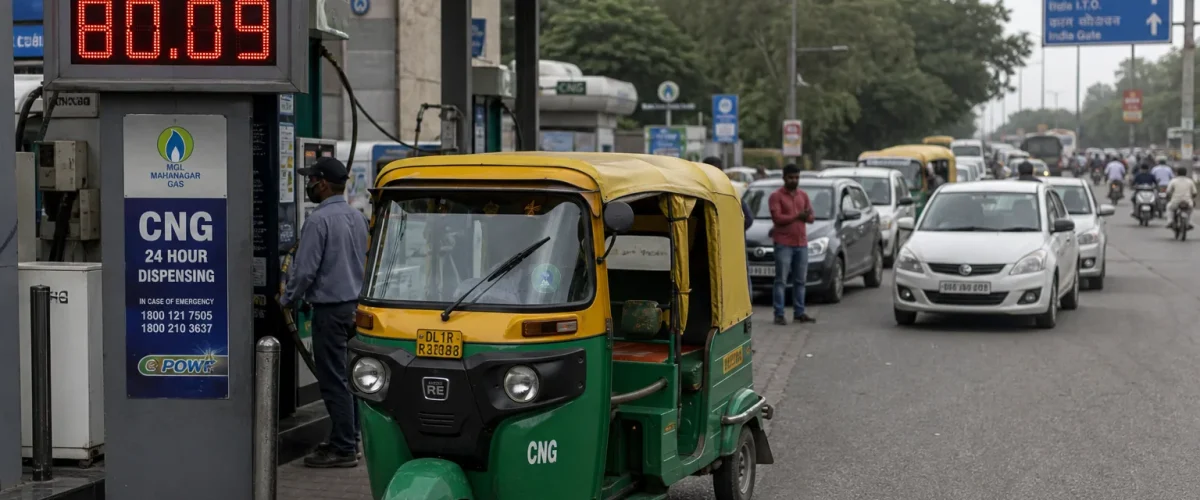
Compressed natural gas prices in the national capital breached the Rs 80 per kilogram mark for the first time on Sunday after Indraprastha Gas Limited announced a fresh hike of Re 1 per kg across its entire distribution network. The increase, effective from 6:00 AM on 17 May 2026, marks the second consecutive price revision in just 48 hours and deepens the fuel cost burden on millions of commuters, auto-rickshaw drivers, and taxi operators in Delhi-NCR.
New CNG Rates Across Delhi-NCR
With the latest revision, CNG in Delhi now costs Rs 80.09 per kg, up from Rs 79.09 per kg just two days earlier. The cumulative increase over the past week stands at Rs 3 per kg, with IGL having first raised prices by Rs 2 per kg on 15 May before adding another Re 1 on Sunday.
The revised rates vary across the NCR region depending on local taxes and transportation costs. In Noida and Ghaziabad, the new price stands at Rs 88.70 per kg, while Gurugram commuters will pay Rs 85.12 per kg. Muzaffarnagar, Meerut, and Shamli now have a revised rate of Rs 88.58 per kg, and Hapur in western Uttar Pradesh has one of the highest rates in the region at Rs 89.70 per kg. Rewari in Haryana saw its price climb to Rs 84.70 per kg, while Karnal stands at Rs 84.43 per kg.
In its official statement, the company said: “The retail selling price of CNG has been increased by Rs 1 per kg w.e.f. 6 AM on 17.05.2026 in all geographical areas of IGL. The revision is in line with the increase in input gas costs.”
Why Are CNG Prices Rising?
The sharp increase in CNG prices is directly linked to the global energy crisis triggered by the ongoing conflict in West Asia. The disruption of oil and gas supplies through the Strait of Hormuz has sent international natural gas prices soaring, with Asian LNG spot prices reaching over $18 per MMBtu in May 2026, compared to $12 per MMBtu at the beginning of the year.
India imports approximately 50 per cent of its natural gas requirement, and the country’s city gas distribution companies, including IGL, are heavily dependent on imported liquefied natural gas to supplement domestic production. As import costs have risen, these companies have passed the burden on to consumers through successive price revisions.
The Petroleum and Natural Gas Regulatory Board (PNGRB) had earlier flagged that domestic gas allocation to city gas distribution companies had been reduced by approximately 15 per cent in the April-September 2026 tranche, forcing companies like IGL to rely more on expensive imported gas.
Impact on Auto-Rickshaw and Taxi Operators
The CNG price hike has hit auto-rickshaw and taxi operators the hardest. Delhi has approximately 90,000 CNG-powered auto-rickshaws and over 80,000 CNG taxis and cabs, making it the largest CNG vehicle fleet in any Indian city. For a typical auto-rickshaw driver who fills 8 to 10 kg of CNG per day, the Rs 3 per kg increase translates to an additional daily cost of Rs 24 to 30, or roughly Rs 720 to 900 per month.
“We are already struggling with low passenger counts because of the heatwave. Now CNG prices are going up every other day. How are we supposed to survive?” said Raju Sharma, an auto-rickshaw driver who has been operating in South Delhi for 12 years. “The government increased fares last in 2022, but our costs have gone up by 40 per cent since then.”
Auto-rickshaw unions in Delhi have demanded an immediate revision in the government-mandated minimum fare and per-kilometre rate. The current fare structure, set in 2022, assumes a CNG price of approximately Rs 60 per kg, well below the current rate of Rs 80.09.
Cascading Effect on Household Budgets
The CNG price hike comes on top of a series of fuel and commodity price increases that have squeezed household budgets across the country. Just three days ago, petrol and diesel prices were raised by Rs 3 per litre, the first revision in four years. Amul and Mother Dairy also hiked milk prices by Rs 2 per litre on 14 May, adding to the inflationary pressure on essential goods.
Piped natural gas (PNG), which is used for cooking in approximately 10 million households across the NCR, has not been revised yet. However, industry analysts expect a PNG price hike in the coming weeks, given that IGL sources its cooking gas from the same imported LNG pool.
“If PNG prices go up as well, it will be a triple whammy for Delhi households — higher cooking gas, higher transport fuel, and higher petrol-diesel costs all within the span of a single month,” said Debasish Mishra, a partner at Deloitte India’s energy practice.
CNG Price Trend Over the Past Year
CNG prices in Delhi have risen by approximately Rs 14 per kg over the past 12 months. In May 2025, the price stood at Rs 66.09 per kg. The sustained increase has been driven primarily by the West Asia conflict, which has disrupted energy supplies globally and pushed India’s energy import bill to record levels.
The government has been reluctant to intervene in city gas pricing, maintaining that CNG and PNG are market-determined products outside the purview of direct government subsidies. However, there is growing political pressure to provide some relief, particularly for public transport operators and low-income households.
What Lies Ahead for CNG Consumers
Energy analysts warn that further CNG price increases are likely in the coming weeks if the West Asia situation does not improve. The Strait of Hormuz, through which approximately 20 per cent of global LNG trade passes, remains partially disrupted despite ongoing ceasefire negotiations between the United States and Iran.
“Until there is a clear resolution to the Hormuz crisis and LNG spot prices come down below $14 per MMBtu, we expect city gas distribution companies to continue passing on cost increases to consumers. Delhi could see CNG prices reach Rs 85 per kg by July if the current trend continues,” said Koushik Chatterjee, an energy sector analyst at Emkay Global Financial Services.
For Delhi’s millions of CNG-dependent commuters and the broader Indian economy, the breach of the Rs 80 mark represents more than a price milestone. It signals a structural shift in the economics of clean fuel transport that could undermine years of progress in encouraging the adoption of CNG over diesel and petrol in India’s most polluted cities.
The Delhi government has so far remained silent on the latest hike, though AAP leaders are expected to raise the issue in the upcoming budget session of the Delhi Assembly, demanding central government intervention in the form of reduced taxes on natural gas or a dedicated CNG subsidy for public transport operators.