Foreign Investors Pull 29.5 Billion Dollars From Indian Equities in 2026 — What Is Behind the Mass Exodus From Dalal Street


India’s equity markets are facing an unprecedented crisis of foreign investor confidence. Foreign portfolio investors (FPIs) have pulled a staggering $29.5 billion from Indian equities in 2026 so far, extending the $18.9 billion sell-off recorded in 2025 and marking the longest sustained period of foreign capital flight from India’s stock markets in over two decades.
The exodus, first reported by CNBC in a detailed analysis of India’s economic challenges, has prompted a fundamental reassessment of the “India growth story” that attracted billions in global investment during the early years of Prime Minister Narendra Modi’s tenure. While India remains the world’s fastest-growing major economy, the gap between that narrative and the reality facing investors has widened significantly.
The Numbers Tell a Stark Story
The cumulative FPI outflow of approximately $48.4 billion over 18 months (2025-2026) represents the largest sustained withdrawal from Indian markets in history. To put this in perspective, even during the 2008 global financial crisis, FPI outflows from India totalled approximately $13 billion — less than a quarter of the current exodus.
Related: Indian Markets See Brief Rally Before Record FII Outflows in March 2026
The sell-off has been broad-based, affecting large-cap blue chips, mid-cap growth stocks, and small-cap speculative plays alike. Sectors that were once FPI favourites — including information technology, financial services, and consumer discretionary — have all seen significant foreign selling. Only a handful of defensive sectors, such as utilities and healthcare, have seen modest net FPI inflows.
The Sensex and Nifty, while still positive for the year thanks to domestic institutional and retail investor support, have significantly underperformed global benchmarks. The Nifty’s year-to-date return of approximately 3% compares unfavourably with gains of 15-20% in US, Japanese, and South Korean indices over the same period.
What’s Driving the Outflows?
Multiple interconnected factors are driving the foreign investor retreat:
1. Slowing Consumer Spending: India’s consumption story, once the primary attraction for foreign investors, has shown visible cracks. Rural demand recovery has been slower than expected, urban discretionary spending has plateaued, and the FMCG sector has reported multiple quarters of volume deceleration. For investors who bought into the “1.4 billion consumers” thesis, the reality of stagnant per-capita consumption growth has been disappointing.
2. Fragile Investment Climate: Despite government efforts to improve ease of doing business, corporate capital expenditure has remained tepid outside of government-directed spending. Private sector investment as a share of GDP has declined, reflecting cautious business sentiment amid global uncertainty and domestic policy unpredictability.
3. Escalating Energy Prices: The ongoing conflict in the Middle East, particularly the US-Iran confrontation, has pushed global oil prices above $90 per barrel. As a major oil importer, India is acutely vulnerable to energy price spikes, which simultaneously worsen the trade deficit, fuel inflation, and squeeze corporate margins.
4. AI and Tech Rotation: The global AI investment boom has concentrated capital in US, Taiwanese, and South Korean technology stocks that are direct beneficiaries of the AI buildout. India’s limited exposure to the semiconductor and AI chip value chain has made it a relative underperformer in tech-heavy global portfolios, prompting allocation shifts away from Indian markets.
5. Valuation Concerns: Indian equities have traded at persistent premiums to emerging market peers, with the Nifty’s price-to-earnings ratio hovering around 22-24x compared to 12-14x for markets like Brazil, South Korea, and Taiwan. Foreign investors increasingly argue that this premium is unjustified given the challenges facing the economy.
The Domestic Investor Buffer
What has prevented a full-blown market crash despite massive FPI selling is the extraordinary strength of domestic institutional investment. Systematic Investment Plans (SIPs) in mutual funds have continued to grow, with monthly SIP flows now exceeding ₹24,000 crore. The Employees’ Provident Fund Organisation (EPFO) and other domestic pension funds have also been steady buyers.
Retail investor participation, which surged during the COVID-19 pandemic and has since become a structural feature of Indian markets, has provided additional support. The number of demat accounts in India has crossed 18 crore, and many of these newer investors are allocating regularly to equity through SIPs and index funds.
Government and RBI Response
The government has downplayed the FPI outflow narrative, emphasising India’s strong macroeconomic fundamentals: a manageable fiscal deficit, comfortable foreign exchange reserves of over $650 billion, and inflation within the RBI’s target band. Officials have argued that the FPI sell-off is a global phenomenon driven by US monetary policy and geo-political uncertainty, rather than a reflection of India-specific weakness.
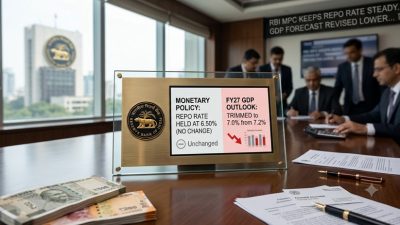
The Reserve Bank of India, for its part, has maintained its neutral monetary policy stance, keeping the repo rate at 5.25% at its latest review. The RBI has also intervened in the foreign exchange market to prevent excessive rupee depreciation, using its substantial reserves as a buffer against capital outflow pressures.
What Lies Ahead
The key question for markets is whether the FPI exodus will abate, stabilise, or accelerate. Bull case scenarios point to a potential reversal if US interest rates begin declining, oil prices stabilise, and India’s corporate earnings growth accelerates in the second half of the fiscal year. Bear case scenarios envision continued outflows if global risk appetite deteriorates further or if India’s growth rate disappoints relative to already-moderated expectations.
For now, India’s equity markets find themselves in an unusual position: still the fastest-growing major economy, still attracting significant FDI, still home to globally competitive companies — but no longer the one-way bet that foreign investors once believed it to be. The India story isn’t over, but it has clearly entered a more complex, nuanced chapter.
Also Read
- FPI Outflows From India Surpass Entire 2025 Total in Just Four Months as Foreign Investors Pull Over Rs 1.8 Lakh Crore From Equities in 2026
- Nasdaq Crashes 5 Percent as AI Bubble Fears Intensify — Could FPI Outflows From US Reverse Back to India
- Foreign Portfolio Investors Withdraw Rs 14231 Crore from Indian Equities in May as 2026 Outflow Crosses Rs 2 Lakh Crore Mark
- Indian Markets End Volatile Week Lower as Oil Surges Past $100 and FPIs Continue April Sell-Off
- SIP Investments Cross ₹25,000 Crore Monthly: How India’s Retail Investors Are Reshaping Markets