BRICS NSA Meeting Begins: Ajit Doval Chairs 10-Nation Security Summit in New Delhi

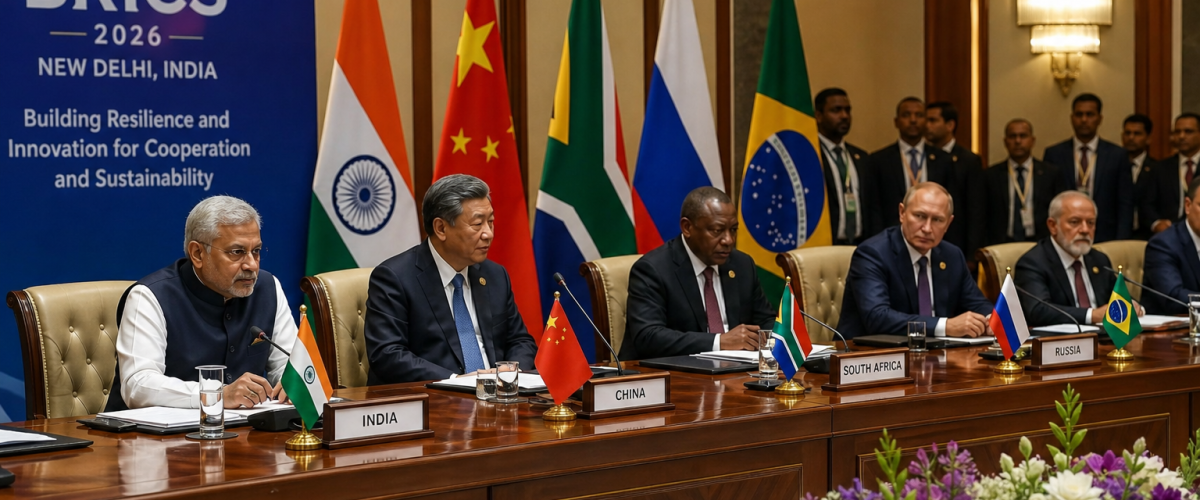
National Security Adviser Ajit Doval has opened the BRICS National Security Advisers’ Meeting in New Delhi today, chairing a two-day summit that brings together the security chiefs of all ten BRICS member nations for discussions on cyber warfare, counter-terrorism, and the security implications of emerging technologies. The meeting — one of the most significant events under India’s 2026 BRICS Chairship — represents India’s largest multilateral security dialogue in recent memory.
The summit’s participant list reads like a who’s who of global security leadership: Chinese Foreign Minister Wang Yi, Russian Security Council Secretary Sergei Shoigu’s representative, and security chiefs from Brazil, South Africa, Egypt, Ethiopia, Iran, Saudi Arabia, and the UAE are all present in the Indian capital. The presence of both Iranian and Saudi Arabian security officials at the same table — facilitated by India’s hosting — is itself a notable diplomatic achievement.
The Opening Session
Doval’s opening remarks set the tone for a meeting designed to find common ground among nations with frequently divergent interests:
Theme: The meeting’s stated focus on “non-traditional security challenges confronting the world today” is a carefully chosen framework. By centring discussions on threats that affect all members equally — cyberattacks on critical infrastructure, terrorist financing networks, AI-powered misinformation — India has created space for productive dialogue that sidesteps the geopolitical fault lines that could otherwise paralyse the conversation.
Related: India-France Adopt Innovation Roadmap 2030 and Launch New Economic Security Dialogue
India’s Positioning: Doval’s role as chair positions India at the centre of the world’s most diverse security dialogue. The meeting allows India to demonstrate its unique diplomatic capability — maintaining strong relationships with both Russia and the Western bloc, engaging constructively with China despite unresolved border tensions, and bridging the Iran-Saudi divide.
The Wang Yi Factor
The most closely watched bilateral interaction will be between Doval and Chinese Foreign Minister Wang Yi. The two men represent nations whose relationship is defined by a complex mix of economic interdependence, strategic competition, and unresolved territorial disputes:
Border Context: The India-China border situation in eastern Ladakh remains a work in progress. While recent rounds of military-level talks have produced some disengagement, the broader trust deficit persists. The Doval-Wang Yi interaction at the BRICS NSA meeting provides a high-level diplomatic channel for managing this relationship — a channel that both sides value even when disagreements run deep.
Strategic Signalling: Wang Yi’s presence in New Delhi — rather than sending a lower-ranking official — signals Beijing’s recognition that the BRICS platform, and India’s hosting of it, cannot be ignored. For India, the optics of hosting China’s top diplomat for a security dialogue chaired by Doval reinforces New Delhi’s status as an indispensable node in the global diplomatic network.
Key Agenda Items
The two-day meeting will cover three primary areas:
Cyber Security: The proliferation of state-sponsored cyberattacks on critical infrastructure — power grids, financial systems, healthcare networks — has made cybersecurity the most urgent shared challenge. The BRICS NSAs will discuss coordinated responses, information-sharing protocols, and norms for state behaviour in cyberspace.
Counter-Terrorism: The meeting will review outcomes from BRICS Joint Working Groups on Counter-Terrorism, with a focus on intelligence-sharing frameworks and the disruption of terrorist financing networks that exploit cryptocurrency and digital payment systems.
AI and Autonomous Systems: The intersection of artificial intelligence with national security — including autonomous weapons systems, AI-powered surveillance, and deepfake-driven disinformation — represents a relatively new but rapidly growing concern where global governance frameworks remain nascent.
What’s at Stake
For India, the BRICS NSA meeting serves multiple strategic objectives: it strengthens the case for permanent UN Security Council membership, demonstrates India’s capacity to manage complex multilateral dialogues, and provides bilateral channels for the most sensitive security relationships. The joint statement expected tomorrow evening will be closely analysed by strategic affairs experts worldwide for signals about the direction of BRICS security cooperation under India’s chairship.
Also Read
- BRICS NSA Meeting Tomorrow: India’s Biggest Security Dialogue Under Ajit Doval
- India to Host BRICS Security Advisers’ Meet: Ajit Doval Chairs June 22-23 Talks on Cyber Threats
- BRICS Agriculture Ministers to Meet in Indore — Five-Day Summit to Focus on Food Security, Smart Farming and AI in Agriculture
- US-Iran MOU Explained: What the Framework Deal Covers and Why It Matters for India’s Energy Security
- G7 Évian Communiqué: Leaders Reaffirm Ukraine Support, Push Back on Russia and China

- Indian Army Gets New Chief as General Dwivedi Hands Over Command Amid Push for Indigenous Defence Tech - July 1, 2026
- Ayodhya Ram Temple Donation Scandal Deepens as Trustees Resign and SIT Arrests Eight - June 29, 2026
- Bengal Seven Weeks On: Modi’s Historic Win and the Questions That Won’t Go Away - June 28, 2026