India and UAE Sign Seven Key Agreements Including USD 5 Billion Investment Package and LPG Supply Deal During PM Modi Abu Dhabi Visit

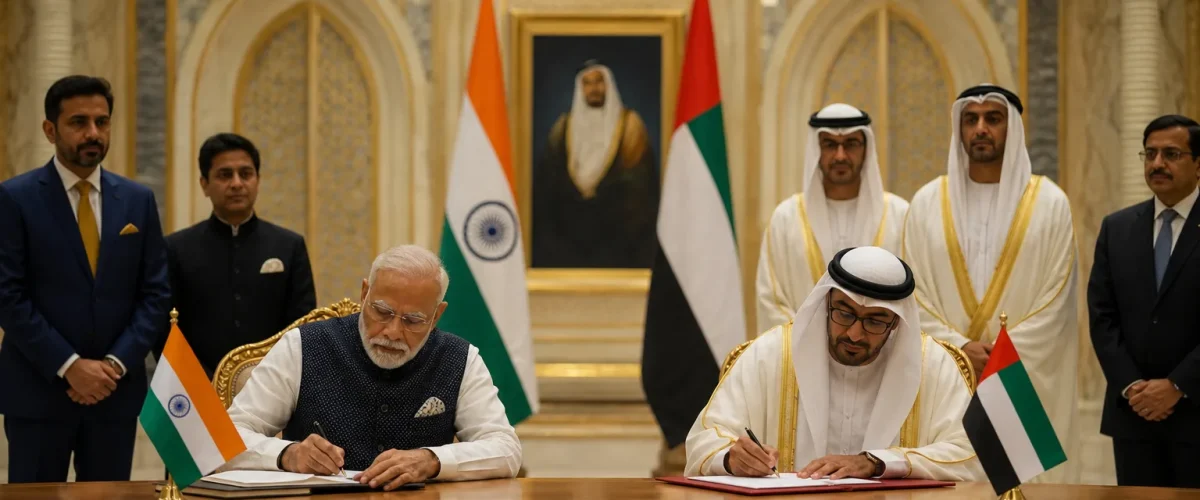
India and the United Arab Emirates on Thursday, 15 May 2026, signed seven major agreements spanning energy security, defence cooperation, maritime infrastructure and investment during Prime Minister Narendra Modi’s visit to Abu Dhabi — the first leg of his six-nation tour. The agreements, signed following talks between Modi and UAE President Sheikh Mohamed bin Zayed Al Nahyan, include a headline USD 5 billion investment commitment by UAE sovereign wealth funds into Indian infrastructure, technology and green energy projects.
The visit — Modi’s fifth to the UAE since 2015 — was widely seen as a crisis-driven engagement, coming at a time when the ongoing US-Iran conflict has severely disrupted energy supply chains through the Strait of Hormuz and pushed global crude oil prices above $100 per barrel. For India, which imports roughly 85 per cent of its crude oil, securing alternative energy supply arrangements with the UAE was a top diplomatic priority.
LPG Supply Deal: A Lifeline for Indian Households
The most immediately impactful agreement was a long-term LPG supply arrangement between Indian Oil Corporation (IOC) and Abu Dhabi National Oil Company (ADNOC). Under the deal, ADNOC will supply an additional 1.2 million tonnes of LPG per year to India through an overland pipeline and shipping route that bypasses the Strait of Hormuz, using the UAE’s Fujairah port on the Arabian Sea coast.
The LPG deal is strategically critical because India is the world’s second-largest LPG importer, consuming approximately 30 million tonnes annually, with over 300 million households dependent on subsidised cooking gas. The Iran war has caused LPG spot prices to surge by 40 per cent since February, and supply disruptions have already led to sporadic shortages in eastern and northeastern Indian states. Rising input costs have already forced dairy companies to hike prices, and any further disruption to LPG supply could have cascading effects on food prices and rural livelihoods.
Petroleum Minister Hardeep Singh Puri, who accompanied Modi on the visit, described the ADNOC deal as “a game-changer for India’s energy security architecture.” He added that the Fujairah route effectively provides an insurance policy against Hormuz disruptions, as Fujairah is located outside the strait on the Gulf of Oman coast, making it accessible even if the Hormuz chokepoint remains contested.
USD 5 Billion Investment Package
The investment commitment of USD 5 billion will flow from the Abu Dhabi Investment Authority (ADIA), Mubadala Investment Company and ADQ into Indian infrastructure, technology and sustainability projects over the next three years. The funds will target four priority sectors: renewable energy (particularly solar and green hydrogen), digital infrastructure, logistics and cold chain development, and healthcare technology.
This brings total committed UAE investment in India to over $30 billion since the Comprehensive Economic Partnership Agreement (CEPA) was signed in 2022, making the UAE one of India’s largest investment partners. The fresh commitment is expected to generate an estimated 80,000 direct and indirect jobs across the targeted sectors.
Industry bodies welcomed the announcement. “UAE capital is exactly what India’s green hydrogen ambitions need right now,” said Sanjiv Puri, chairman of ITC and president of the Confederation of Indian Industry. “These investments will accelerate the energy transition at a time when the fossil fuel vulnerability has never been more apparent.”
Defence Pact and Maritime Cooperation
A defence cooperation agreement signed during the visit provides a framework for joint military exercises, defence manufacturing and intelligence sharing. The pact is particularly significant for naval cooperation in the Indian Ocean and the Arabian Sea, where both countries have shared interests in securing maritime trade routes and combating piracy.
A separate agreement establishes a ship repair cluster at Vadinar port in Gujarat’s Devbhumi Dwarka district, jointly developed by Indian and UAE maritime companies. The Vadinar facility will be capable of servicing large cargo vessels and oil tankers, reducing India’s dependence on Singapore, Dubai and European facilities for major ship repairs. The cluster is expected to attract investments of Rs 4,000 crore and create 15,000 jobs in coastal Gujarat. The attack on the Indian cargo ship Haji Ali near the Strait of Hormuz has underscored the need for India to develop its own maritime repair and rescue capabilities.
Technology and AI Cooperation
The two countries also agreed to establish a joint AI research centre, building on the India-UAE Start-Up Bridge launched in 2024. The centre will focus on applications of artificial intelligence in healthcare diagnostics, agricultural yield prediction, smart city management and financial fraud detection. India’s Atal Innovation Mission and the UAE’s Mohamed bin Zayed University of Artificial Intelligence (MBZUAI) will jointly run the centre, which will be headquartered in Abu Dhabi with a satellite office in Bengaluru.
A bilateral agreement on mutual recognition of academic qualifications was also signed, which will facilitate the movement of students and professionals between the two countries. This is particularly relevant for the estimated 3.5 million-strong Indian community in the UAE, many of whom face challenges in having their Indian qualifications recognised by UAE employers and regulatory bodies.
Strategic Context: Navigating the Energy Crisis
The depth and breadth of the agreements reflect the urgency with which both countries are seeking to deepen their partnership amid a volatile global environment. For India, the UAE visit was primarily about energy security — the RBI Governor’s recent warning that further fuel price hikes are inevitable unless the West Asia crisis de-escalates has added pressure on the government to secure alternative supply chains.
For the UAE, which has positioned itself as a neutral mediator in the Iran conflict while maintaining close ties with Washington, deepening the India relationship serves both economic and diplomatic purposes. India is the UAE’s second-largest trading partner, with bilateral trade exceeding $85 billion in 2025-26, and the UAE is keen to diversify its economy beyond oil through investments in India’s growing technology and consumer markets.
The Modi-Al Nahyan talks also touched on the humanitarian situation in the Persian Gulf, where thousands of Indian workers are stranded due to shipping disruptions. The UAE agreed to facilitate the repatriation of affected Indian workers through chartered flights and to provide consular assistance to Indian nationals in the region.
Following his UAE visit, PM Modi flew to the Netherlands on Friday evening, where he will hold talks with Dutch PM Rob Jetten and meet the Dutch royal family. The six-nation tour — the longest foreign trip by an Indian PM in over five years — reflects the government’s multi-pronged strategy to navigate the economic challenges posed by the Iran war and global energy disruption.