100 Percent Ethanol Fuel Gets Legal Recognition in India — Nitin Gadkari’s Big Push for Energy Independence

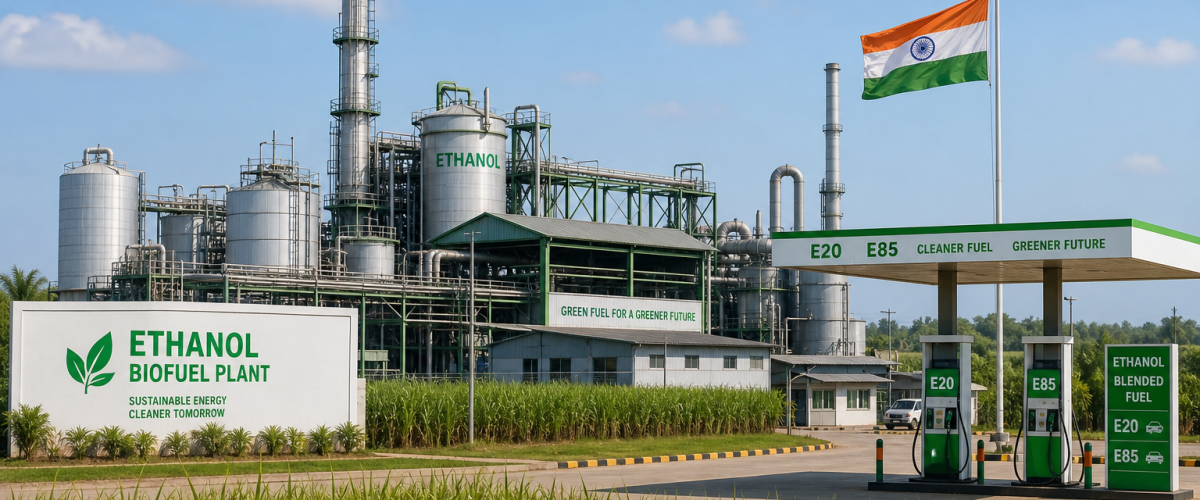
Union Minister for Road Transport and Highways Nitin Gadkari has announced that the government has given legal recognition to 100 percent ethanol as a motor fuel in India, clearing the way for vehicles to run entirely on ethanol without any petrol blending. The landmark decision, announced on June 13, marks a transformative step in India’s decades-long quest for energy independence and could fundamentally reshape the country’s fuel economy.
Speaking at an industry event, Gadkari revealed that the file granting legal approval for 100 percent ethanol fuel has been cleared, removing the regulatory barrier that previously limited ethanol’s use to blending with petrol at ratios of up to 20 percent (E20). The decision opens the door for flex-fuel vehicles — capable of running on any combination of petrol and ethanol — to operate on pure ethanol, dramatically reducing India’s dependence on imported crude oil.
Why 100 Percent Ethanol Matters
India imports approximately 85 percent of its crude oil requirements, spending over $120 billion annually on oil imports — a figure that represents one of the largest drains on the country’s foreign exchange reserves. The vulnerability this creates was starkly illustrated during the ongoing Middle East crisis, where the US-Iran conflict and disruptions to the Strait of Hormuz sent global oil prices soaring above $90 per barrel, directly impacting Indian consumers and businesses.
Ethanol, derived primarily from sugarcane, corn, and other agricultural feedstocks, offers a domestically produced alternative to imported petroleum. India is the world’s second-largest sugarcane producer, and the country has significant capacity to increase ethanol production from agricultural waste, damaged grains, and purpose-grown energy crops.
The environmental benefits are equally significant. Ethanol burns cleaner than petrol, producing fewer particulate emissions, lower carbon monoxide levels, and reduced greenhouse gas emissions on a lifecycle basis. In a country where urban air pollution causes an estimated 1.2 million premature deaths annually, the shift to ethanol could deliver meaningful public health improvements.
India’s Ethanol Blending Journey
India’s ethanol programme has evolved significantly over the past decade. The government set an ambitious target of achieving 20 percent ethanol blending with petrol (E20) by 2025, a goal that has been largely achieved ahead of schedule. The blending ratio has been progressively increased from less than 2 percent in 2014 to approximately 18-20 percent currently, saving billions of dollars in oil import costs.
The move to 100 percent ethanol represents a quantum leap from the blending programme. While E20 requires no vehicle modifications and is compatible with all modern petrol engines, running on 100 percent ethanol requires flex-fuel vehicle (FFV) technology — engines and fuel systems designed to handle the different combustion characteristics of pure ethanol.
Several major automobile manufacturers, including Maruti Suzuki, Toyota, and Hyundai, have already developed flex-fuel prototypes for the Indian market. Toyota showcased a flex-fuel variant of the Innova HyCross at an Auto Expo, and industry sources suggest that commercial launch of FFVs could begin within 12-18 months of the legal framework being finalised.
Impact on Farmers and Rural Economy
Perhaps the most far-reaching impact of the ethanol fuel decision will be on India’s agricultural sector. Ethanol production creates a guaranteed industrial demand for sugarcane and other crops, stabilising farm incomes and providing an alternative revenue stream for farmers who have historically been vulnerable to commodity price fluctuations.
Gadkari has repeatedly emphasised the rural economic development potential of ethanol, arguing that it can transform farmers from being dependent on the vagaries of commodity markets to being participants in the energy economy. Decentralised ethanol production facilities in rural areas could create employment, boost local economies, and reduce the urban migration that strains India’s cities.
The sugar industry, which has long struggled with cyclical surpluses and arrears owed to farmers, stands to benefit significantly. By diverting a portion of sugarcane production to ethanol, the government can simultaneously address sugar surplus issues, improve farmer payments, and reduce oil imports — a rare policy trifecta.
Challenges and the Road Ahead
The transition to 100 percent ethanol faces several challenges. Current ethanol production capacity, while growing rapidly, is insufficient to replace a significant portion of India’s petrol consumption. Scaling production to the required levels will require massive investment in distillery infrastructure, feedstock supply chains, and distribution networks.
Additionally, the flex-fuel vehicle ecosystem — including fuelling stations, vehicle manufacturing capacity, and consumer awareness — needs to be built from scratch. The pricing of ethanol fuel relative to petrol will be a critical factor in consumer adoption, and the government will need to establish a regulatory framework that ensures fair pricing while maintaining production incentives.
Despite these challenges, Gadkari’s announcement signals clear political will to pursue the ethanol pathway aggressively. With the Middle East crisis highlighting the risks of oil dependency, rising global awareness of climate change demanding cleaner fuels, and India’s agricultural sector seeking new revenue sources, the stars appear to be aligning for ethanol’s moment in India’s energy story.
Also Read
- Petrol and Diesel Prices Hiked Again by 90 Paise Per Litre Across India in Second Fuel Price Increase Within Five Days as Oil Crisis Deepens
- Petrol and Diesel Prices Hiked by Rs 3 Per Litre Across India as Government Raises Fuel Rates for First Time in Four Years Amid Iran War Oil Crisis
- Reliance’s Ambani Green Energy Giga Complex Ships First Batch of High-Efficiency Solar Modules from Jamnagar — India’s Clean Energy Push Gets Major Boost
- West Asia Crisis Threatens India’s Energy Security as Oil Prices Surge Past 109 Dollars
- India April CPI Inflation Expected to Rise to 3.8 Percent as LPG Price Hike and Fuel Costs Push Household Budgets Higher Amid Global Energy Crisis