Kerala Election Results 2026: Congress-Led UDF Returns to Power as Left Front’s Historic Bid for Consecutive Terms Falls Short

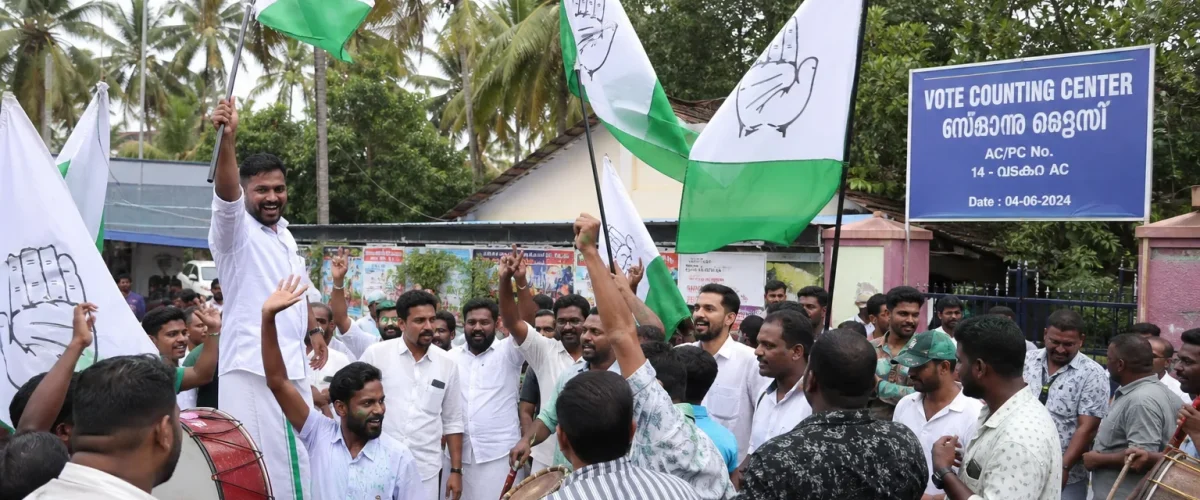
UDF Crosses Halfway Mark as Kerala Returns to Its Tradition of Alternating Governments
The Congress-led United Democratic Front (UDF) has crossed the halfway mark in the Kerala Assembly Elections 2026, with early counting trends on Monday, 4 May 2026, showing the alliance leading in 77 or more seats in the 140-member Kerala Legislative Assembly. The result effectively ends the Left Democratic Front’s (LDF) ambitious attempt to become the first alliance in Kerala’s history to win consecutive terms in power.
Counting of votes began at 8:00 AM IST across all 140 constituencies, and by mid-morning, a clear trend had emerged in favour of the UDF. With the majority mark at 71 seats, the UDF’s lead of 77+ seats provides a comfortable margin that appears unlikely to change as remaining rounds are counted. VD Satheesan, the Congress state president who led the UDF campaign, is emerging as the frontrunner to become Kerala’s next Chief Minister.
Kerala’s Pendulum Swings Back: The Alternation Tradition Holds
Kerala has a unique political tradition of alternating between the LDF and UDF in every assembly election since 1982. The LDF, led by Chief Minister Pinarayi Vijayan, broke this pattern in 2021 when it won 99 seats — the first time any alliance retained power in Kerala in four decades. Many had wondered whether 2026 would confirm a permanent shift in voting behaviour or represent a one-off exception.
The results suggest the latter. Kerala’s voters have returned to their historical pattern, handing the LDF a clear defeat despite the Vijayan government’s relatively stable five-year term. The state’s 78.27 per cent voter turnout — lower than the 2021 figure but still robust — suggests that the electorate was engaged and deliberate in its choice.
What Went Wrong for Pinarayi Vijayan and the LDF
The LDF’s defeat can be attributed to several converging factors. First, the unemployment crisis among Kerala’s educated youth — the state has one of India’s highest literacy rates but also among the highest youth unemployment — remained unresolved despite promises. Second, fiscal stress plagued the government’s finances, with revenue deficits constraining welfare spending in the final two years.
Third, the LDF faced allegations of policy inconsistencies and intra-alliance tensions, particularly between the CPI(M) and CPI. The workers’ rights discourse that traditionally forms the Left’s core appeal was somewhat diluted by the government’s courting of private investment and its handling of industrial disputes.
Pinarayi Vijayan’s personal dominance of the LDF campaign, while initially seen as an asset, may have also alienated sections of the electorate that perceived it as autocratic. His handling of the natural disaster response infrastructure was praised by some but criticised by others as insufficiently proactive.
VD Satheesan: From Underdog to Chief Minister in Waiting
The UDF’s victory is a personal triumph for VD Satheesan, who was appointed Congress state president in 2021 and has spent five years rebuilding the party’s organisation from the ground up. His strategy of focusing on governance accountability, fiscal transparency, and unemployment as campaign pillars proved effective in cutting through the LDF’s incumbency advantages.
Satheesan’s leadership style — more grassroots-oriented and issue-driven than the traditional Congress approach — is credited with reinvigorating the party’s booth-level organisation. The Congress itself is leading in a significant share of UDF’s seats, a result that will boost the party’s morale nationally amid its struggles in several other states.
BJP Still Marginal in Kerala
The BJP-led NDA, which had hoped to make significant gains in Kerala and establish itself as a third force, appears to have made only modest progress. While the party has improved its vote share marginally compared to 2021, translating that into seats in Kerala’s closely contested constituencies has proven difficult. The state’s political landscape remains fundamentally bipolar between the LDF and UDF, with the BJP struggling to break through.
This contrasts sharply with BJP’s dramatic performance in West Bengal, where the party is making history on the same counting day. Kerala’s ideological and demographic profile continues to present unique challenges for the BJP’s organisational model.
What the UDF Victory Means for Kerala and India
The incoming UDF government will inherit a state facing significant economic challenges. Kerala’s public debt has ballooned, the state’s tax revenues have been under pressure, and the cost of living crisis — exacerbated by rising fuel prices and record LPG costs — has hit middle-class households hard. How Satheesan addresses these fiscal constraints while fulfilling campaign promises of job creation and welfare expansion will define his tenure.
Nationally, the Congress will draw encouragement from the Kerala result, which adds to its tally of state-level victories and provides a much-needed boost to the party’s claim that it remains a viable alternative to the BJP. However, the simultaneous losses in West Bengal and other states remind the opposition that victories remain concentrated in specific pockets rather than representing a national wave.
Kerala’s 2026 election ultimately reinforces the state’s exceptional political culture — one where voters hold governments accountable, alternate power regularly, and resist national trends in favour of local priorities. As counting concludes and the UDF prepares for government formation, Keralites can take pride in a democracy that continues to function with remarkable vigour and independence.