Petrol and Diesel Prices Hiked by Rs 3 Per Litre Across India as Government Raises Fuel Rates for First Time in Four Years Amid Iran War Oil Crisis

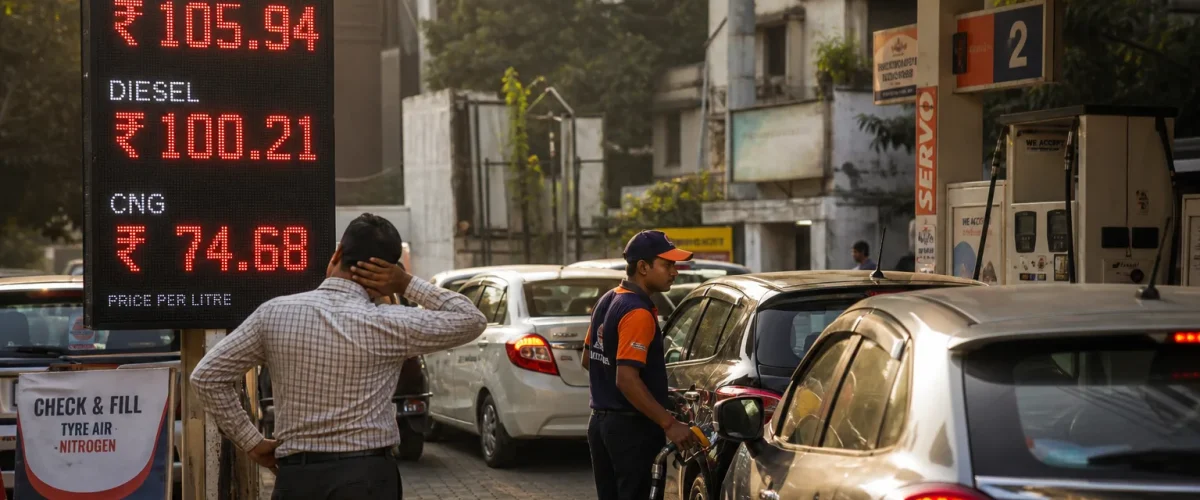
State-run oil marketing companies on Friday, 15 May 2026, raised petrol and diesel prices by Rs 3 per litre across India — the first fuel price revision in nearly four years — as mounting losses from the Iran war-driven crude oil surge left the government with no option but to pass on a fraction of the increased costs to consumers. Compressed natural gas (CNG) prices in Delhi were simultaneously hiked by Rs 2 per kilogram, adding to the burden on public transport operators and daily commuters who had switched to gas-powered vehicles as a cheaper alternative.
Following the revision, which took effect immediately, petrol in Delhi now costs Rs 97.77 per litre — up from Rs 94.77 — while diesel has risen to Rs 90.67 per litre from Rs 87.67. In Mumbai, petrol prices climbed to Rs 106.68 per litre after a hike of Rs 3.14, and diesel now costs Rs 93.14 per litre. Kolkata saw the steepest increase among metros, with petrol rising by Rs 3.29 to Rs 108.74 per litre and diesel climbing to Rs 95.13 per litre. Chennai petrol now stands at Rs 103.67 per litre, with diesel at Rs 95.25.
City-Wise Fuel Price Breakdown After the Hike
The differential pricing across cities reflects the varying state taxes, value-added tax (VAT) rates and transportation costs that are added on top of the base price set by oil marketing companies. In Bengaluru, petrol has risen to Rs 106.17 per litre from Rs 102.96, while diesel now costs Rs 88.94 per litre. Hyderabad, Jaipur, Lucknow and Patna have also seen proportional increases, with petrol crossing the Rs 100 mark in most state capitals for the first time since the informal price freeze began in early 2022.
The previous fuel price revision was implemented on 22 May 2022, when the government reduced excise duty on petrol by Rs 8 per litre and on diesel by Rs 6 per litre ahead of state elections. Since then, oil marketing companies — Indian Oil Corporation (IOC), Bharat Petroleum Corporation (BPCL) and Hindustan Petroleum Corporation (HPCL) — have absorbed the rising global crude costs, accumulating combined losses that industry analysts estimate at over Rs 30,000 crore in the current financial year alone.
Why the Government Could No Longer Hold the Line
The timing of the hike is directly linked to the ongoing US-Iran conflict, which has disrupted global energy supply chains since it erupted on 28 February 2026. The effective blockade of the Strait of Hormuz — through which approximately 20 per cent of the world’s oil passes — has sent Brent crude prices above $100 per barrel and kept them elevated for over ten weeks. India, which imports roughly 85 per cent of its crude oil requirements, has been particularly vulnerable to the price surge.
The RBI Governor had warned earlier this week that a fuel price hike was inevitable if the West Asia crisis persisted, and the government appears to have heeded that warning. Oil Secretary Neeraj Mittal had recently insisted at the CII Annual Business Summit that “there is no fuel shortage in the country and no plan to introduce rationing,” but acknowledged that the pricing situation was unsustainable for OMCs.
Industry experts noted that the Rs 3 increase covers only about one-tenth of the loss that would need to be recouped to fully offset the global price surge. “This is a calibrated, politically cautious hike rather than a market-correcting one,” said Debasish Mishra, an energy analyst at Deloitte India. “The OMCs are still absorbing the vast majority of the impact, and further revisions are likely if crude stays above $95 per barrel through the monsoon season.”
Impact on Household Budgets and Inflation
The fuel price hike is expected to have a cascading effect on the broader economy. Transportation costs — which form a significant component of the price of virtually every good and service — will rise, pushing up prices of everything from vegetables and groceries to manufactured goods and e-commerce deliveries. Economists estimate that a Rs 3 increase in diesel prices typically adds 15 to 20 basis points to wholesale price inflation within 60 to 90 days.
For the average Indian household, the impact is both direct and indirect. A family that consumes 50 litres of petrol per month will see their fuel bill increase by Rs 150 per month, or Rs 1,800 per year. But the indirect effects — higher prices for food, transport and daily essentials — are likely to be far more significant, particularly for lower-income households that spend a larger proportion of their income on these items.
The hike comes at a particularly sensitive time, with India’s April CPI inflation already rising to 3.8 per cent and food inflation at 4.2 per cent. The additional fuel cost is expected to push May inflation higher, potentially complicating the Reserve Bank of India’s monetary policy stance at its next review in June. The RBI had cut the repo rate by 25 basis points in April to support growth, but persistent inflationary pressures from energy costs may limit the scope for further easing.
CNG Hike Hits Public Transport and Delivery Economy
The Rs 2 per kg increase in CNG prices in Delhi — from Rs 77.09 to Rs 79.09 per kg — is particularly significant because CNG-powered vehicles form the backbone of public transport in the national capital region. Auto-rickshaws, city buses, app-based cabs and last-mile delivery vehicles overwhelmingly run on CNG, and any increase in its price directly affects commuters and the gig economy workforce.
Auto-rickshaw unions in Delhi have already demanded a revision of fare meters to reflect the higher fuel costs, while delivery platform companies such as Zomato, Swiggy and Amazon have warned that they may need to adjust delivery charges. “Every rupee increase in CNG costs us Rs 40-50 per day in additional fuel expenses,” said Rajendra Soni, general secretary of the Delhi Auto-Rickshaw Sangh. “We will be forced to demand a meter fare revision if the government does not provide us relief.”
Political Fallout and Opposition Criticism
The fuel price hike has triggered sharp criticism from opposition parties. Congress president Mallikarjun Kharge described the hike as “a cruel blow to the common man at a time when household budgets are already stretched to breaking point.” The party demanded that the government reduce central excise duty on fuel rather than passing the burden to consumers.
In response, the BJP defended the decision as an act of “economic patriotism,” arguing that the government had shielded consumers from the full impact of the global oil shock for over four years. “Around 82 countries have imposed emergency restrictions, rationing, or sharp price hikes. India has done none of this,” a BJP spokesperson said, pointing to the significantly steeper price increases seen in European and Asian markets.
The political sensitivity of fuel prices in India cannot be overstated. Previous governments have lost elections partly due to fuel price management, and the BJP — which aggressively attacked the UPA government over fuel prices during its opposition years — is keenly aware of the electoral risks. PM Modi’s recent appeal for fuel conservation and austerity measures was widely seen as preparation for the inevitable price increase.
What Comes Next: More Hikes or Relief?
The key question for Indian consumers is whether the Rs 3 hike is a one-time adjustment or the beginning of a series of increases. Analysts are divided. Some believe that the government will absorb further losses through budgetary adjustments and hope that the Iran conflict de-escalates before another hike becomes necessary. Others argue that the OMCs’ financial position is so strained that monthly revisions of Rs 1-2 per litre may be necessary to prevent a full-blown fiscal crisis.
Much depends on the trajectory of global crude oil prices. If the US-Iran conflict shows signs of de-escalation — as diplomatic efforts at the Trump-Xi summit and BRICS meetings suggest is possible — prices could moderate, giving the government room to hold off on further increases. But if the Hormuz blockade persists and crude stays above $100, Indian consumers should prepare for more pain at the pump in the weeks ahead.
For now, the Rs 3 hike marks a significant shift from the government’s four-year policy of keeping fuel prices artificially stable. Whether it provides sufficient relief to the beleaguered oil companies, or merely delays a larger reckoning, remains to be seen. What is clear is that the Indian economy’s vulnerability to global energy shocks has been laid bare once again — a reminder that energy security and diversification must remain at the top of the national policy agenda.